

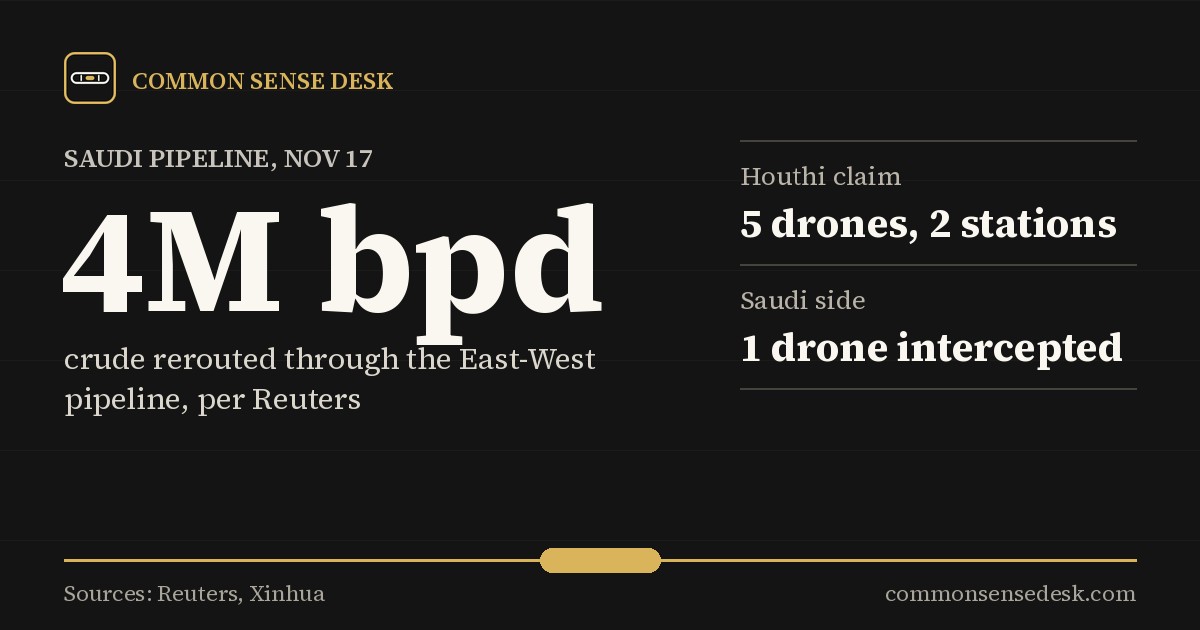
Yemen's Houthi rebels say they sent five drones at two pumping stations on Saudi Arabia's East-West oil pipeline on Tuesday, November 17. They claim direct hits and big fires. Saudi Arabia hasn't confirmed any damage, and nobody has been able to check the claim independently, Reuters reported.
This pipeline matters far beyond Saudi Arabia. With shipping through the Strait of Hormuz disrupted by the Iran war, it has become one of the main ways Saudi oil reaches the world.
What the Houthis claim
Houthi military spokesman Yahya Saree said three drones hit Pumping Station No. 9, in two waves, and two more hit Pumping Station No. 8, according to Xinhua and Reuters. The stations are in the Riyadh area. He said the attack scored "direct and precise hits" and caused major fires.
That's the Houthis' version. They've claimed several attacks on the same pipeline this month.
What Saudi Arabia says
There was no immediate confirmation from Saudi authorities about the pipeline, according to Reuters. Turki al-Maliki, spokesman for the Saudi-led coalition fighting the Houthis in Yemen, said on X that the coalition intercepted and destroyed a Houthi drone headed toward the Riyadh region. He didn't say what it was aimed at or whether anything was damaged.
Saudi Aramco, the state oil company that runs the pipeline, hadn't commented publicly on Tuesday's claim.
So for now, the facts on the record are a Houthi claim of hits and a Saudi statement that one drone was shot down. Those two don't match, and the gap may not close until satellite images or company statements come out.
Why this pipeline is so important right now
The East-West pipeline runs about 1,200 kilometers across the country, from oil fields in the east to the port of Yanbu on the Red Sea. Normally, much of Saudi oil leaves through the Persian Gulf and the Strait of Hormuz. Since the Iran war disrupted that route, Saudi Arabia has sent about 4 million barrels of crude a day through the pipeline to Yanbu instead, according to Reuters. That's roughly 4% of all the oil the world uses.
In other words, the pipeline is Saudi Arabia's way around Hormuz. Its neighbors in the Gulf don't have as good a workaround, which is why their exports have been hit harder.
That's also why the Houthis keep going after it. Any real damage that shut it down for long would squeeze world supply at a time when the Gulf is already a war zone.
A wider fight
The Houthis, who are backed by Iran and control much of northern Yemen, are also fighting the Saudi-led coalition at home. Saudi defenses shot down two Houthi cruise missiles aimed at Riyadh this week. The coalition says its strikes on Tuesday hit 60 military targets in Yemen, and the Houthi-run Saba news agency says 17 people were killed over 24 hours, a figure that hasn't been independently confirmed.
The Houthis have also pushed toward Aden and the Bab el-Mandeb strait at the mouth of the Red Sea, which we covered in our Yemen story. Control of that strait would give them more power over shipping headed to and from the Suez Canal.
At the same time, Iran has kept up attacks on tankers in the Strait of Hormuz and fired drones at U.S. bases in Kuwait and Bahrain this week, as we reported in our Hormuz story.
For your wallet
If the Houthi claim turns out to be overstated, as some past claims have been, the effect on oil prices should be small. If the pipeline does go down for a while, it would be a bigger deal: Saudi Arabia would have fewer ways to get oil out, and prices could jump.
U.S. gas has been falling, to a national average of $3.81 a gallon on Monday, according to AAA. Trouble on the Saudi pipeline, on top of tanker attacks near Hormuz, is the kind of thing that could stall that drop before Thanksgiving. Diesel and heating oil usually react first.
What to watch
- Any statement from Saudi Aramco or Saudi Arabia's energy ministry on damage.
- Satellite images of the two pumping stations.
- Oil prices, and whether loadings at Yanbu slow down.
Sources
- Reuters (via BOE Report): Yemen's Houthis say they launched drones towards Saudi East-West pipeline (Nov. 17, 2026) boereport.com
- Xinhua: Yemen's Houthis claim drone attacks on Saudi oil pipeline (Nov. 18, 2026) english.news.cn
- AP (via The Tribune): Iran widens Gulf attacks (Nov. 18, 2026) tribuneindia.com