

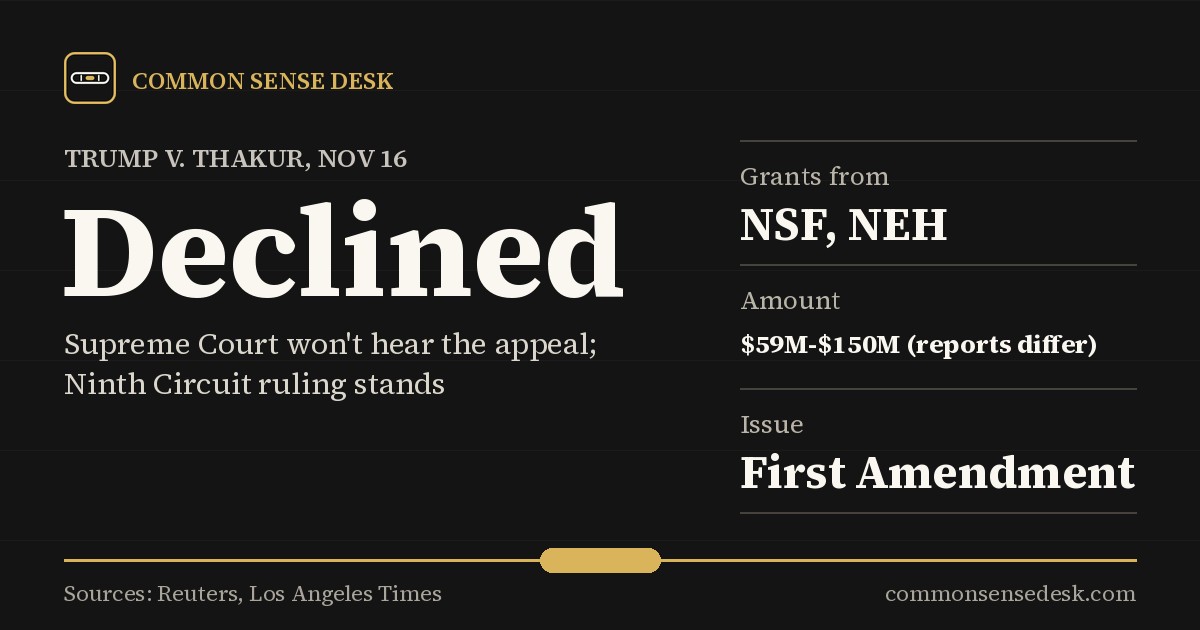
The Supreme Court on Monday, November 16, turned down the Trump administration's appeal over cuts to federal research grants held by University of California researchers. The justices gave no explanation and no one noted a dissent. That leaves in place a lower court ruling that cutting the grants likely violated the researchers' free-speech rights.
It's a narrow decision, but it touches a big fight: how far the government can go in pulling money from projects because of what they're about. Here's what happened and what it does and doesn't mean.
What was cut
After President Trump signed an executive order aimed at "ending radical and wasteful government DEI programs," several federal agencies sent form letters ending research grants, according to the Los Angeles Times. The case at the Supreme Court involved grants from the National Science Foundation and the National Endowment for the Humanities to UC researchers.
The letters ended grants based on keywords like diversity, equity or "environmental justice," and told researchers their projects no longer fit "agency priorities," the Times reported.
Reports differ on the amount. Reuters put the cut grants at about $59 million; the Los Angeles Times said about $150 million in UC research grants was at issue. Either way, it's a small piece of a nationwide fight over several billion dollars in canceled federal grants. The UC system took in more than $4 billion in federal grant money in 2024.
How it got to the Supreme Court
Six UC professors filed a class-action lawsuit, known as Trump v. Thakur. A federal district court blocked the cuts. In May, the U.S. Court of Appeals for the Ninth Circuit agreed, but narrowed the case to one question: free speech.
The appeals court said the government can choose which programs to fund, but it may not use "its power to punish or suppress disfavored expression," and can't turn away qualified recipients because of their viewpoint.
What each side argued
Solicitor General D. John Sauer, the administration's top lawyer at the Supreme Court, said the Ninth Circuit got the First Amendment wrong, and that its ruling could limit the government's power to decide how to spend money. "Vast sums of taxpayer money are at stake," he told the court.
On the other side, UC Berkeley law school dean Erwin Chemerinsky urged the court to turn down the appeal, arguing that "ideologically driven attempts to suppress a particular point of view are presumptively unconstitutional in funding."
What "declining to hear" means
This part matters. When the Supreme Court declines to take a case, it isn't ruling on who's right. It just leaves the lower court's decision in place. So the Ninth Circuit's ruling stands for these researchers, but it doesn't set a nationwide rule. The bigger constitutional question, how far the government can go in cutting grants based on their subject, is still open and could come back to the court in another case.
It's also worth noting the court has gone the other way in related fights. In separate, larger cases involving health and education grants, it said claims over canceled grants generally belong in a special court for money claims against the government, not regular federal courts.
The common-sense middle
There's a fair point on each side. Taxpayers have every right to expect the government to set priorities, and no researcher is entitled to federal money forever. But once a grant is awarded, cutting it off because of a viewpoint the people in power dislike is a different thing, and the First Amendment has long been read to limit that. Whichever party holds power, that's a line worth protecting, because the next administration could use the same tool on the other side's projects.
What it means for you
For most people, the direct effect is small: some UC research projects keep their funding. The bigger stakes are in how federal research dollars get spent, which affects universities, jobs in college towns and the scientific work behind new treatments and technologies. It's also a reminder that the courts are still sorting out where the government's spending power ends and free speech begins.
What to watch next
- Other grant-cut lawsuits working their way through the courts.
- Whether the administration tries a different legal route to cut similar grants.
- Any case that gives the Supreme Court a clean shot at the First Amendment question.
We may earn a commission from Amazon links on this page, at no extra cost to you. As an Amazon Associate, Common Sense Desk earns from qualifying purchases.
Sources
- Los Angeles Times (via The Spokesman-Review): Supreme Court turns down Trump's plan to cut off UC research grants spokesman.com
- Reuters (via U.S. News): Supreme Court rejects Trump appeal defending diversity-related grant cuts usnews.com