

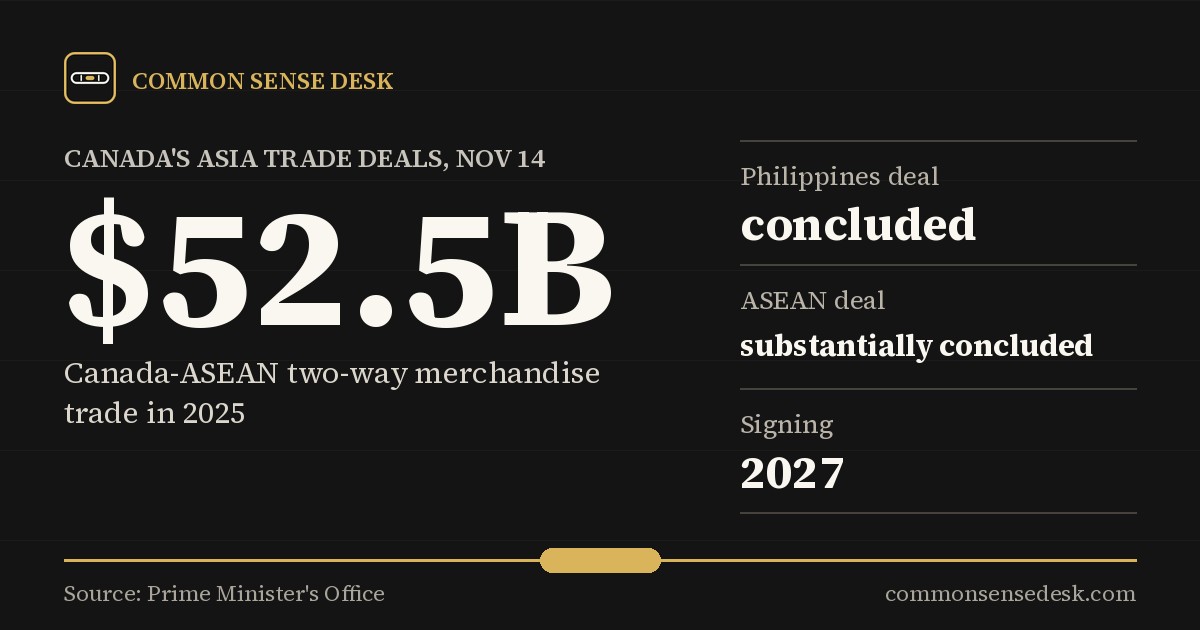
Canada has finished negotiating a free trade agreement with the Philippines and has "substantially concluded" talks on a broader deal with the Association of Southeast Asian Nations, Prime Minister Mark Carney announced in Manila on Saturday, November 14. Both deals are expected to be signed in 2027.
It's part of a deliberate push to sell more to the rest of the world while trade talks with the United States drag on. Here's what's in it and what it could mean.
What was announced
According to the Prime Minister's Office:
- Canada-Philippines: negotiations are concluded, just one year after the two countries announced they would pursue a deal. Both sides are working toward signing in 2027.
- Canada-ASEAN: negotiations, which began in 2021, are "substantially concluded," with signing targeted for 2027. Some final steps remain.
"With the Philippines, we concluded a new free trade agreement in just one year," Carney said. International Trade Minister Maninder Sidhu said: "Trade diversification is our Plan A."
The numbers
The government says:
- ASEAN, a bloc of almost 700 million people with an economy of close to $6 trillion, was Canada's fifth-largest merchandise trading partner in 2025, with $52.5 billion in two-way trade, up 22.7% from 2024.
- Once in force, the ASEAN deal is expected to add nearly $2 billion to Canada's economy and create nearly 14,000 jobs, mainly in agriculture and manufacturing.
- Canada-Philippines trade reached $3.4 billion in 2025. The government says the new deal could triple exports to the Philippines by 2035, especially farm and forest products.
Those projections come from the government, and estimates like these depend on a lot of assumptions. They're a guide, not a guarantee.
What ASEAN is
ASEAN, the Association of Southeast Asian Nations, is a regional group of 11 countries: Brunei, Cambodia, Indonesia, Laos, Malaysia, Myanmar, the Philippines, Singapore, Thailand, Timor-Leste and Vietnam. They range from rich city-states like Singapore to fast-growing economies like Vietnam and Indonesia. Canada already trades freely with four of them, Brunei, Malaysia, Singapore and Vietnam, through the Comprehensive and Progressive Agreement for Trans-Pacific Partnership, the Pacific Rim trade pact Canada joined in 2018. The new deal would extend better access to the rest of the group, including big markets like Indonesia and Thailand where Canada has no trade agreement today.
Why it matters now
Canada sells most of what it exports to the United States, and Trump's tariffs have made that relationship far less predictable. Carney's government has been racing to open other markets, from Europe to Asia. Just this week, he also said Canada could turn to Chinese, European or Japanese automakers if talks with Washington fail, as we covered in our story on Carney and Chinese automakers.
Southeast Asia is one of the fastest-growing regions in the world. The Philippines alone has more than 110 million people, and countries like Vietnam, Indonesia and Thailand are growing middle-class markets for Canadian food, energy and technology.
The Philippines talks weren't smooth. Carney suspended them in late August over last-minute demands, reports said, before they were revived and wrapped up.
The fine print
A trade deal on paper isn't the same as trade in practice. Both deals still have to be signed, put through each country's approval process and brought into force, which can take years. Southeast Asian markets also have their own protections; the Philippines, for example, plans a temporary halt on some imports later this month under pressure from its own producers, according to reports. And no amount of new trade with Asia replaces the U.S. market, which is far bigger and right next door.
Still, adding customers is common sense for any business, and for any country. A farmer who sells to ten buyers sleeps better than one who sells to only one, and the same goes for a trading nation.
What it means for your wallet
For most families, nothing changes soon. Over time, deals like these mean more markets for Canadian farmers, food producers, forestry and manufacturers, which supports jobs and wages, especially in the Prairies and rural Canada. Lower tariffs can also mean more choice and lower prices on some imported goods. The bigger point is resilience: the more customers Canada has, the less a single trade fight can hurt.
What to watch next
- Formal signing of both deals in 2027.
- Details on which tariffs come down, and how fast.
- Whether U.S.-Canada trade talks make progress.
We may earn a commission from Amazon links on this page, at no extra cost to you. As an Amazon Associate, Common Sense Desk earns from qualifying purchases.
Sources
- Prime Minister of Canada: Canada concludes negotiations for two new free trade agreements with the Philippines and ASEAN pm.gc.ca
- AFP (via France 24): Canada's Carney touts Philippine trade deal on Asia tour france24.com