

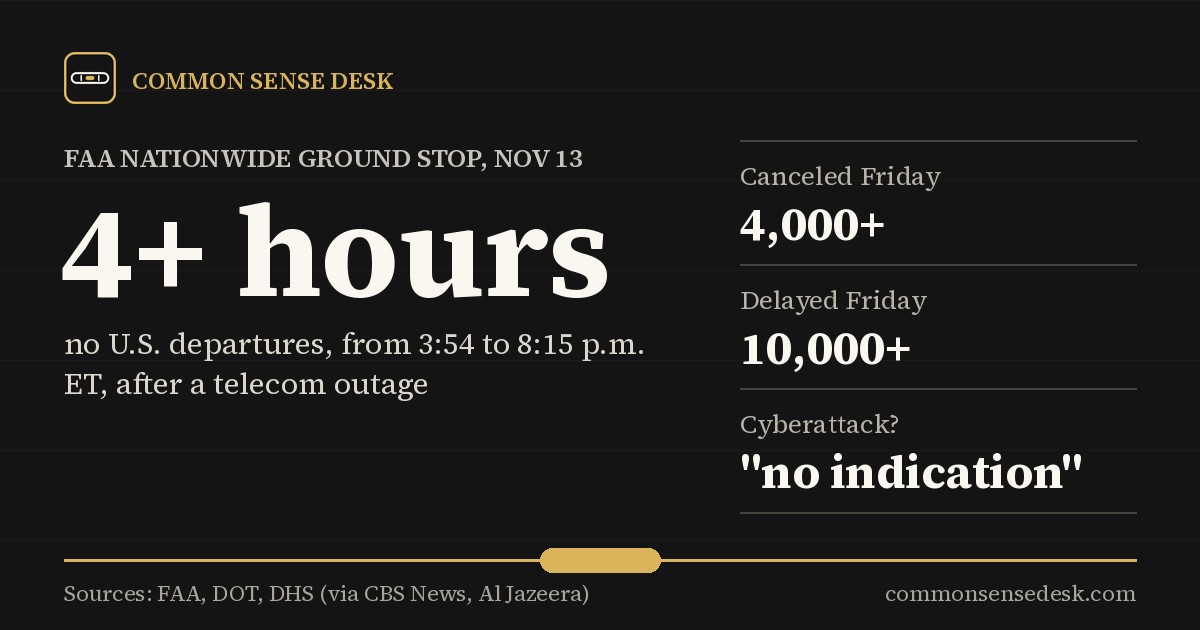
For more than four hours on Friday, November 13, nothing took off from any U.S. airport. The Federal Aviation Administration ordered a nationwide ground stop because of a telecommunications outage in the system that connects air traffic controllers. The FAA lifted it at 8:15 p.m. Eastern, but the ripple effects ran into the weekend, with thousands of flights canceled.
Here's what happened, what officials say caused it, and what to do if your trip was hit, or if it happens again before Thanksgiving.
What happened
- 3:54 p.m. ET: the FAA issued the ground stop, citing "extraordinary circumstances and reasons for safety," according to Al Jazeera and CBS News. Planes already in the air were allowed to keep flying and land.
- 8:15 p.m. ET: the airspace reopened. "We've opened up the airspace," Transportation Secretary Sean Duffy said. "It's going to be slow."
- The FAA said it had "thoroughly tested our systems to confirm they were stable and that operations remain reliable," according to CBS News.
It was the longest nationwide ground stop in 25 years, Al Jazeera reported. Former National Transportation Safety Board chairman Robert Sumwalt called it "absolutely unprecedented" and said the last major ground stop before this was after 9/11, according to CBS News.
How many flights were hit
- Flight tracker FlightAware listed more than 10,000 delays and over 4,000 cancellations on Friday, according to CBS News. Flightradar24 counted more than 4,700 cancellations, and about 700 cancellations already made for Saturday, according to Al Jazeera.
- By 7:05 p.m. ET, at least 827 flights had been diverted: 670 went back to where they took off, and 157 landed somewhere else, according to data cited by Al Jazeera.
- Delays hit big airports from Boston, New York and Baltimore to Atlanta, Miami and Los Angeles.
- Homeland Security Secretary Markwayne Mullin said everyone in the air was accounted for. "Everybody's safe," he said.
What caused it
Officials say it was a breakdown in old equipment, not an attack. Here's what's on the record:
- The FAA blamed a telecommunications outage affecting the centers that guide planes between airports.
- Duffy said switches and routers became overloaded with data and failed. "We have old switches, old routers," he said. He said there was no total loss of communications or radar.
- Mullin said new security patches added to the older system appeared to "overwhelm" its routers, according to CBS News.
- Multiple sources told CBS News that an update to the private communications network that connects air traffic control caused the system to reboot and crash. That network is run by the contractor L3Harris, which didn't immediately comment.
Was it a cyberattack? Mullin said there was "no indication, as of yet, that this was a nefarious act against us," but that the investigation is ongoing.
Was it linked to the Microsoft outage? No. Mullin said there was no connection to the worldwide Microsoft outage that hit email and office systems the same week, according to CBS News.
An old problem
None of this is a surprise to people who follow the system. A 2023 safety review ordered by the FAA called its telecommunications network obsolete and warned that a failure could cut off whole regions, CBS News reported. A Government Accountability Office report in September warned about aging copper cables and slow upgrades, according to Al Jazeera. Duffy has asked Congress for emergency funding and says a full replacement could cost $50 billion. "You will have more of these," he warned.
The common-sense take: Americans fly on one of the busiest air systems in the world, and parts of it run on decades-old technology. Fixing it isn't cheap or exciting, but this is what happens when it waits too long.
What it means for you
If your flight was canceled or delayed:
- Check the airline's app first. Rebooking is usually faster there than in line at the airport.
- If your flight was canceled and you'd rather not fly, federal rules adopted in 2024 require airlines to refund your ticket to the original form of payment, not just give you a voucher, if you decline the rebooking. Refunds are due within 7 business days for credit cards.
- For long delays, refund and compensation rules have changed recently, so ask the airline exactly what it offers before you accept a voucher.
- Don't count on free hotels or meals this time. Airlines' promises for meals and hotels usually cover delays they caused. This one was an FAA outage, so policies vary. It's still worth asking.
- Keep your receipts. If you had to pay for a hotel or meals, travel insurance or a credit card's trip protection may cover some of it.
For Thanksgiving: Duffy says he expects the system to be back to normal before the holiday rush, which starts in less than two weeks. Still, it's smart to book morning flights when you can, avoid tight connections, pack medicine and essentials in your carry-on, and download your airline's app before you leave home.
What to watch next
- The official cause, once the investigation is done.
- Whether Congress approves money to replace the air traffic control network.
- How quickly airlines get back on schedule this weekend.
Sources
- CBS News: FAA lifts nationwide ground stop that disrupted thousands of flights cbsnews.com
- Al Jazeera: FAA ground stop lifted, why were US flights grounded, and what's next? aljazeera.com
- NBC News: FAA lifts ground stop as U.S. airports grapple with thousands of canceled flights nbcnews.com
- Federal Register: Refunds and other consumer protections (DOT rule, 2024) federalregister.gov