

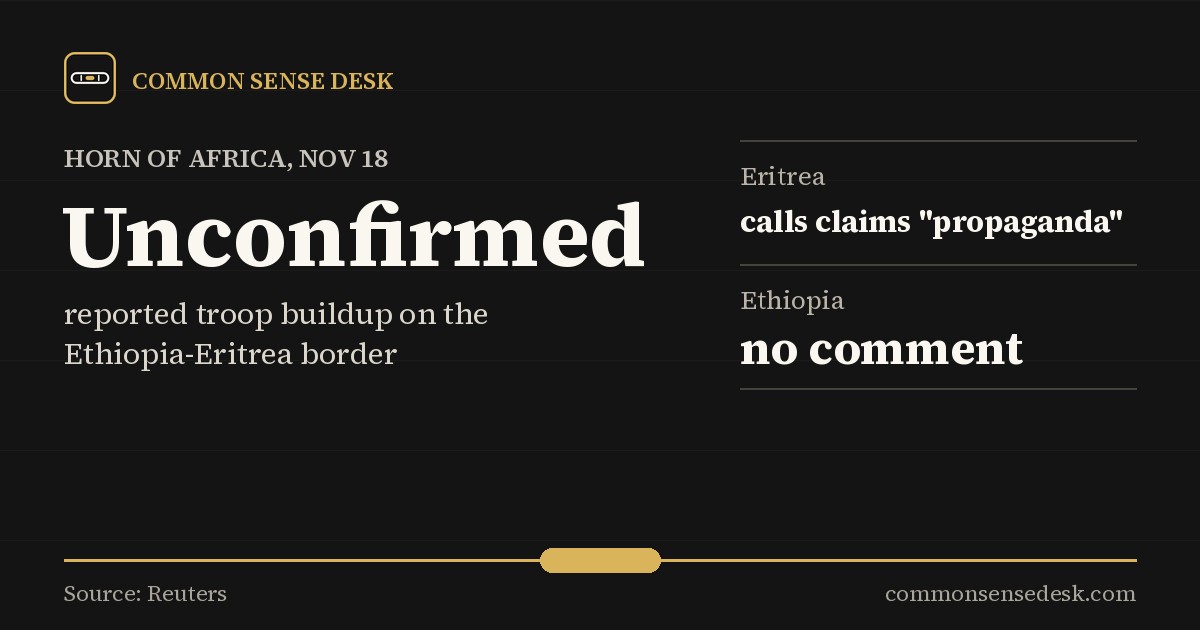
Ethiopia and Eritrea have moved large numbers of troops up to their shared border, bringing the two armies "within striking distance" of each other, Reuters reported on Wednesday, November 18. The report cites conflict monitors and people close to armed groups in Ethiopia's Tigray region. Reuters said it couldn't independently confirm the buildup.
Neither government has confirmed it either, and the claims come mostly from monitors and armed groups, so it's worth treating the details with care until there's more independent reporting.
Eritrea called Ethiopian claims "propaganda," and Ethiopia's spokespeople didn't respond to Reuters.
What's being reported
Two groups that track conflicts around the world, ACLED and the International Crisis Group, say both armies are now massed along the frontier. ACLED says the two sides have clashed in recent days, which would be their first direct fighting in more than a month.
According to ACLED, on November 12 Ethiopian drones struck what were likely Eritrean positions near Badme, a border town the two countries fought over in the past. Eritrean artillery fired back, and the two armies clashed the following day.
Not everyone agrees. A person close to the Tigray Peace Force, a militia that backs Ethiopia's federal government, said there have been no clashes between Ethiopian and Eritrean forces.
What each side says
Eritrea: Information Minister Yemane Gebremeskel dismissed statements from Ethiopia's ruling party as "propaganda." He didn't address the reports about troops or fighting. Eritrea has denied sending forces into Tigray and accuses Ethiopia of looking for an excuse to invade.
Ethiopia: The government didn't comment to Reuters. Earlier, Ethiopia's government and witnesses said Eritrean forces crossed into Tigray in early October to support rebels there. Ethiopia also accuses Sudan and Egypt of backing the rebels, which both countries deny.
How it got here
The two neighbors have a long and painful history.
Eritrea broke away from Ethiopia and became independent in 1993. From 1998 to 2000, the two fought a border war, centered on Badme, that killed tens of thousands of people. A border commission later placed Badme on the Eritrean side, but the dispute dragged on for years.
In 2018, Ethiopia's new prime minister, Abiy Ahmed, made peace with Eritrea. He won the Nobel Peace Prize the following year, largely for that deal.
Two years later, war broke out in Tigray, Ethiopia's northern region, between the federal government and the Tigray People's Liberation Front. Eritrea's army fought on Ethiopia's side. That war, from 2020 to 2022, was one of the deadliest of this century, with huge losses among civilians from fighting, hunger and lack of medical care. It ended with a peace deal in late 2022.
Since then, Ethiopia and Eritrea have drifted apart again. A big reason is the sea. Ethiopia has no coastline of its own, and Abiy has said repeatedly that his country needs access to the Red Sea. Eritrea, which sits on that coast, sees those comments as a threat. Abiy says Ethiopia will only pursue sea access peacefully.
In September this year, new fighting broke out between Ethiopia's government and Tigrayan rebels, which is what has pushed the two militaries back toward each other.
Why it matters
Magnus Taylor, an analyst at the International Crisis Group, warned that fighting between Ethiopia's army and the rebels near the border could pull Eritrea in, in "a dangerous scenario that could trigger a direct conflict" between the two countries.
The Horn of Africa is already under strain. Sudan, next door, has been torn by civil war since 2023, and Somalia to the east has its own long-running conflict. Fighting between Ethiopia and Eritrea could send more people fleeing across borders in a region where millions already depend on food aid.
The region also sits along one of the world's most important shipping lanes. Ships moving between the Red Sea and the Suez Canal pass Eritrea's coast, and the Bab el-Mandeb strait at the southern end is already a flashpoint because of Yemen's Houthi rebels. A wider war nearby would add more risk to a route that carries a large share of world trade.
What to watch
- Whether either government confirms the troop buildup or the clashes.
- Any outside push for talks. The African Union and neighboring countries have tried to calm tensions before.
- The situation for civilians in Tigray, who are caught in the middle again.
Sources
- Reuters (via Al-Monitor): Ethiopia and Eritrea amass forces along border, heightening war fears, sources say (Nov. 18, 2026) al-monitor.com
- Reuters (via U.S. News): Ethiopia and Eritrea amass forces along border usnews.com