

We may earn a commission from Amazon links on this page, at no extra cost to you. As an Amazon Associate, Common Sense Desk earns from qualifying purchases.
Two pieces of tech news this week touch the cards and phones most of us pay with. Apple says a problem with its own software update knocked out Apple Pay, iCloud and other services for several hours on Tuesday, November 17. And Visa says a hacking incident hit one of its outside vendors, not its own systems, after a criminal group claimed it had stolen data from Visa and JPMorgan Chase.
Neither looks like a disaster for ordinary cardholders so far. But both are worth understanding.
The Apple outage
Problems started late Tuesday morning, Eastern Time. Apple's System Status page flagged an AppleCare problem at 11:15 a.m., and user reports jumped on the outage-tracking site Downdetector at about 11:40 a.m., according to Time. By just before 1 p.m., roughly 2,000 people were reporting trouble with Apple Pay, iCloud and Apple Support. Some users said they were unexpectedly signed out of iCloud on their iPhones and Macs. The App Store and AppleCare purchases were also hit.
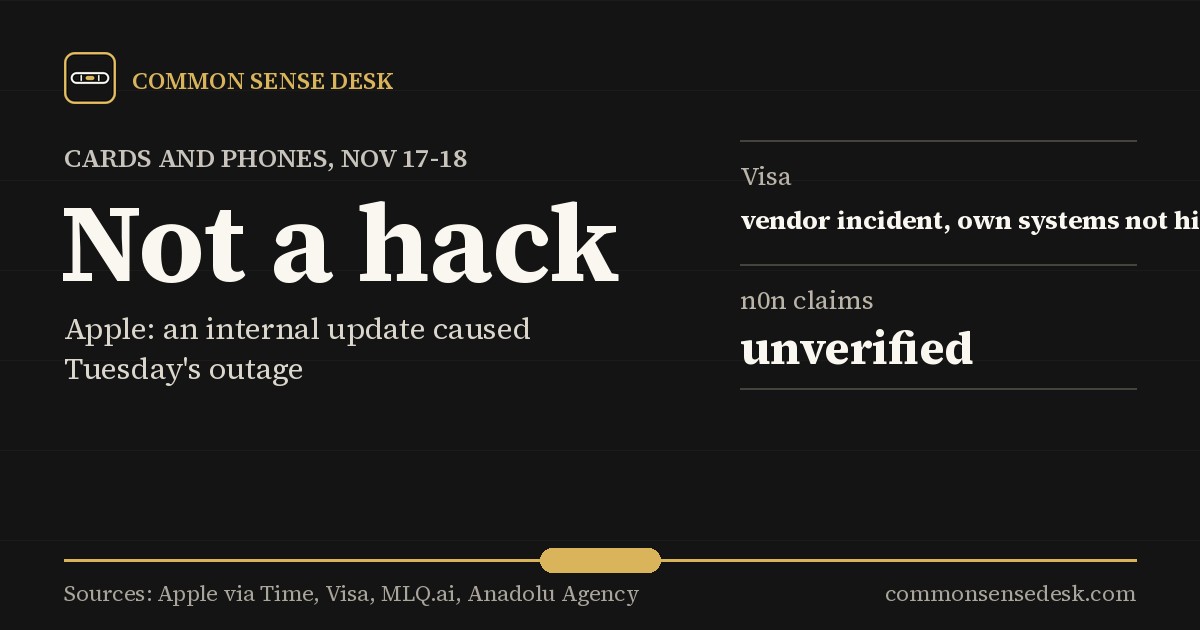
Apple blamed itself. "Many of our systems are back up and running after an internal update caused some outages this morning," the company said. Apple said it was not a cyberattack.
By Tuesday evening, Apple's status page showed all services back to normal.
It was the latest in a string of big tech outages in the past week. Microsoft, a JPMorgan Chase software bug and a United Airlines system all caused problems, and none was blamed on hackers. Secretary of State Marco Rubio told reporters in the Philippines this week, "We are not under systemic attack," saying authorities found no evidence linking the outages to cyberattacks, according to Anadolu Agency.
The Visa hack claim
On Monday, November 16, a criminal group calling itself n0n listed 59 organizations in 11 countries on its leak site, according to MLQ.ai and the security site Ransomnews. It gave Visa and JPMorgan Chase 48 hours to negotiate before it would leak data.
What n0n claims to have:
- For Visa and Mastercard, records from card-member programs in Asia-Pacific, the Middle East and Africa, including names, emails, phone numbers and travel and dining bookings. The group hasn't claimed card numbers.
- For JPMorgan Chase, email campaign records for a premium card program.
None of those claims has been independently verified.
Visa confirmed a security incident at an outside provider. "Visa's systems were not involved and were not impacted," the company said, adding there's no sign payment data was affected. Visa hasn't named the provider. Security reporting says the vendor is in the Asia-Pacific region.
JPMorgan Chase has said its outage on Monday came from a software bug in its own hardware and wasn't cyber-related, as we covered in our Chase story. We found no public statement from Mastercard on n0n's claims.
Should you worry?
Based on what's public, probably not much. The claimed data, if real, is marketing and loyalty-program information, not card numbers or PINs. And the outages this week came from software mistakes, not attacks.
But data like names, emails and travel bookings is exactly what scammers use to make fake messages look real. That's the bigger practical risk.
Simple steps for cardholders
- Be suspicious of messages about your card. If you get an email or text saying your card was "compromised" in the Visa news, don't click links. Call the number on the back of your card.
- Turn on alerts. Most banks can text you for every purchase. It's the fastest way to spot fraud.
- Check your statements for small charges you don't recognize. Thieves often test a card with a few dollars first.
- You're protected. Under federal rules and card network policies, your liability for unauthorized credit card charges is limited, and often zero if you report quickly.
- Use strong sign-ins. Turn on two-factor authentication for your Apple account, email and banking apps.
- Have a backup. This week showed that phones and payment apps can go down. Carrying one physical card or a little cash helps. A hardware security key can also lock down your most important accounts.
What to watch
- Whether n0n actually posts any data after its deadline, and whether security researchers confirm it's real.
- Whether Visa names the vendor or notifies affected customers.
- Any follow-up from Apple on what went wrong with its update.
Sources
- Time: What to know about the Apple outage (Nov. 17, 2026) time.com
- MLQ.ai: Visa says a breach claimed by the n0n extortion gang began at an Asia-Pacific vendor (Nov. 18, 2026) mlq.ai
- Ransomnews: n0n lists Eli Lilly, Visa and JPMorgan; Visa blames supplier ransomnews.com
- Anadolu Agency: Morning briefing, Nov. 18, 2026 aa.com.tr