

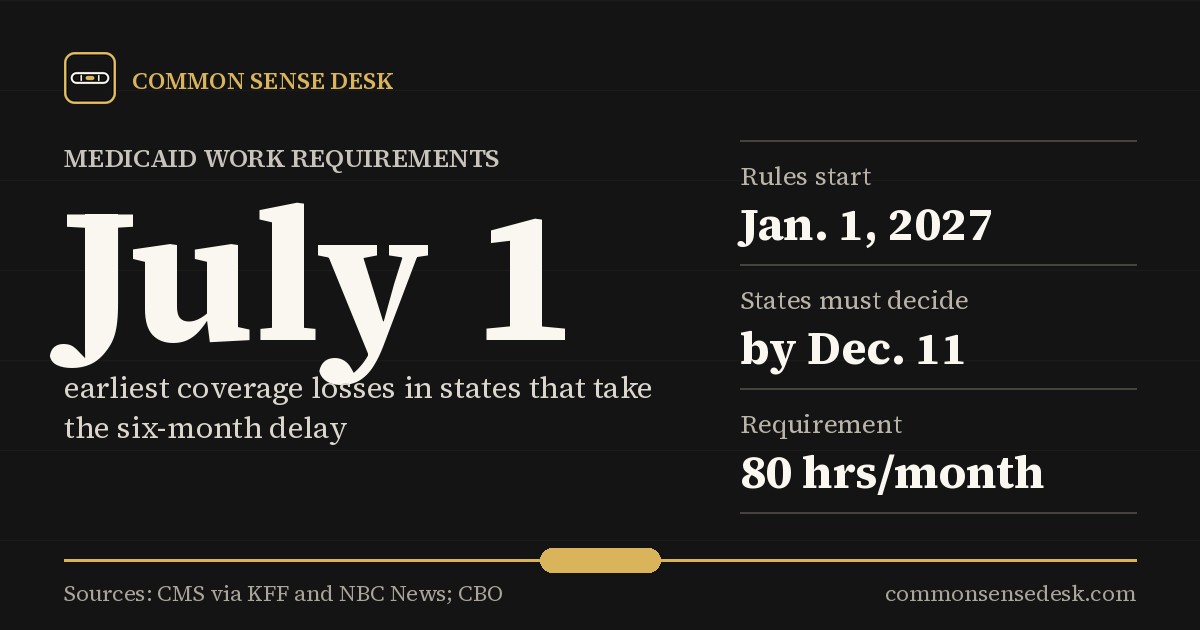
The Trump administration is giving states six extra months before anyone can lose Medicaid for failing to meet the program's new work requirements. The Centers for Medicare & Medicaid Services (CMS) announced on Friday, November 13, that states can choose a "hold harmless" period through June 30, 2027. The requirements still officially start January 1, but in states that opt in, no one will lose coverage for not complying before July 1.
Here's who's affected, what changes and what doesn't.
The work requirement, in plain words
The 2025 budget law, the One Big Beautiful Bill Act, requires many able-bodied adults under 65 on Medicaid to show 80 hours a month of work, volunteering or school to keep their coverage, NBC News reported. There are exemptions, including for people who are medically frail, and other groups the law spells out.
Supporters say it's a common-sense expectation: if you're able to work, you should work, volunteer or train to stay on a taxpayer-funded program. The Congressional Budget Office estimated the work requirements would save the federal government $317 billion over about a decade. It also estimated they would leave 5.3 million more people uninsured by 2034.
What CMS announced
According to KFF and NBC News:
- States can ask for a "hold harmless" period of up to six months, through June 30, 2027. It's optional.
- States that use it must still start checking whether people meet the requirements or qualify for an exemption on January 1.
- But they can hold off on denying applications or dropping people who are otherwise eligible but haven't shown they meet the rules.
- States have to keep working toward full compliance: updating computer systems, training staff and reaching out to enrollees. They must tell CMS by December 11 if they want the delay.
"States have made real progress," said Dan Brillman, who oversees Medicaid at CMS. The White House declined to comment, NBC News reported.
Why the delay
CMS didn't spell out a single reason, but the pressure had been building. State officials and health care advocates warned the rollout was moving too fast and that eligible people could lose coverage over paperwork. Five Democratic governors asked Health and Human Services Secretary Robert F. Kennedy Jr. to postpone, saying their agencies weren't ready. Virginia's health secretary said he expects to accept the grace period and called the original timeline unrealistic, Politico reported.
There was also a court ruling. Last month, a federal judge blocked part of CMS's rule on the medical frailty exemption, finding it could wrongly cause some people to lose coverage. Because of that ruling, states now only need to verify that a person has a condition in one of the five categories the law lists, not prove that it limits their ability to work, according to KFF.
What's happened where it already started
Nebraska launched its requirements early, on May 1. Through August, more than 1,000 people there had lost coverage or been denied benefits, according to state figures cited by NBC News. Both sides point to numbers like that: supporters say it shows the rules are being enforced; critics say many of those people may have been eligible but tripped over paperwork.
What both sides say
Critics welcomed the delay but said it doesn't solve the problem. "Today's news lets states delay the harm," said Sarah Lueck of the left-leaning Center on Budget and Policy Priorities. Democrats have pledged to repeal the work rules if they gain majorities, and they take control of the Senate in January.
Supporters of the policy see the delay as a practical step to get the rollout right, not a retreat. The law still stands, and the requirements still take effect.
The honest middle ground: most people agree with the idea that able-bodied adults should work if they can. The real fight is over whether people who already work, or qualify for an exemption, end up losing coverage just because the paperwork was too hard. A six-month runway to fix the systems is a reasonable answer to that worry.
What it means for you
If you or someone in your family is on Medicaid and between 19 and 64:
- Nothing changes overnight. Your state will still start asking about work, volunteering or school from January 1.
- Respond to any notice from your state Medicaid office. Most coverage losses in programs like this come from missed paperwork, not from people being ineligible.
- Keep records of work hours, school enrollment or volunteering, and any medical condition that could qualify you for an exemption.
- Check whether your state opts into the delay by December 11.
What to watch next
- Which states sign up for the six-month delay.
- Whether the court fight over exemptions expands.
- Any move by the new Congress to change or repeal the rules.
Sources
- KFF: CMS announces optional 6-month delay for enforcing Medicaid work requirements kff.org
- NBC News: Trump administration delays Medicaid work requirements by six months nbcnews.com
- Politico (via Yahoo News): Trump administration allows states six more months to stand up Medicaid work rules yahoo.com