

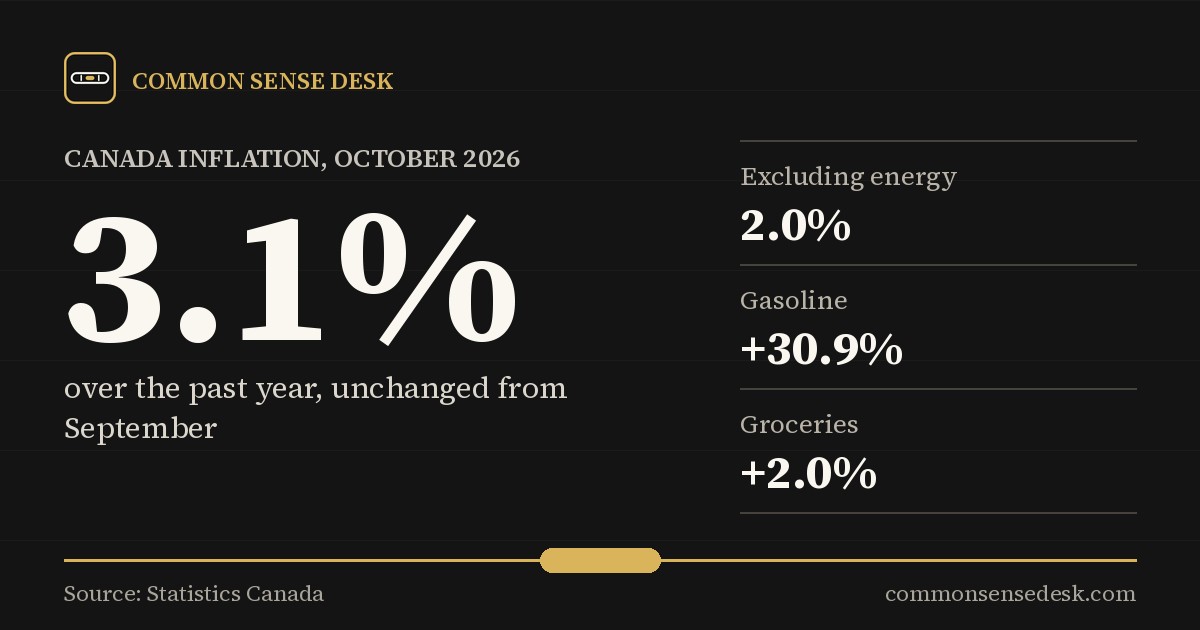
Canada's inflation rate held steady at 3.1% in October, the same as September, Statistics Canada said on Monday, November 16. Economists polled by Reuters had expected a slightly higher 3.2%. The big driver is still gasoline, up nearly 31% from a year ago.
Here's what went up, what went down, and what it means for your budget and for interest rates.
The key numbers
From Statistics Canada's release:
- Overall inflation: 3.1% over the past year, the same as in September. Month to month, prices rose 0.2%.
- Without energy: 2.0%, down from 2.1% in September. That's right at the Bank of Canada's 2% target.
- Gasoline: up 30.9% from a year ago, faster than September's 27.8%, partly because prices were low a year earlier. Month to month, gas actually fell 2.5%.
- Groceries: food from stores up 2.0% over the year, faster than 1.7% in September. Grocery prices are up 31.9% since October 2020.
- Shelter: up 1.4%, with rent growth slowing. Ontario rents were up 1.1%.
Other things that moved
- Transportation overall was up 8.9%, mostly because of gas.
- Clothing rose 1.8% over the year, after falling 0.3% in September; it jumped 3.4% in a single month.
- Natural gas in Ontario was up 3.0% from a year earlier, after being down 18.7% in September.
- Property taxes rose 5.9% in Newfoundland and Labrador this year, and 4.5% in Manitoba, after a 19.5% jump there last year.
Prices rose more slowly in five provinces than they did in September, Statistics Canada said. In British Columbia, the slowdown was mostly because rents are rising more slowly.
What went down
A few bits of good news:
- Cell phone service: down 6.2% from a year ago, after rising 0.8% in September.
- Property taxes: still rising, but more slowly, up 3.8% compared with 5.6% a year earlier.
Why gas is the story
Take energy out, and Canada's inflation is basically at the Bank of Canada's target. Gasoline is the reason the headline number is above 3%. Oil prices jumped this year on tension with Iran and fears about the Strait of Hormuz, and gas at the pump followed. Prices have been easing in recent weeks as those fears cooled, which is why gas actually fell in October compared with September. If that continues, the yearly gas number should come down too, pulling overall inflation with it.
U.S. gas prices tell the same story; we track them in our weekly gas price update.
Inflation, in plain words
An inflation rate of 3.1% means that, on average, the same basket of everyday things, food, rent, gas, clothing, phone bills, costs 3.1% more than it did a year ago. The Bank of Canada aims to keep that number around 2%, within a range of 1% to 3%. So October's headline is just above the top of that range, while the number without energy sits right on target. That split is why economists keep saying the problem right now is mostly the price of fuel, not prices across the board.
What it means for interest rates
The Bank of Canada watches the numbers without energy and its core measures closely. With inflation excluding energy at 2.0%, there's less pressure for the bank to raise rates, even with the headline at 3.1%. That's different from the U.S., where hotter inflation has markets expecting the Federal Reserve to hike in December, as we covered in our U.S. inflation story.
For Canadians with a variable-rate mortgage or a renewal coming up, that's reasonably good news: steady core inflation makes a sudden rate jump less likely. It doesn't mean rates will fall soon, though.
What it means for your wallet
The plain version: your grocery bill is still climbing, a bit faster than last month, and gas is far more expensive than a year ago, but easing. Rent increases are slowing, and phone bills are actually down.
Common-sense moves that still work:
- Fill up mid-week and use a gas price app; prices vary a lot even in the same city.
- Shop store brands and flyers for groceries; the gap with name brands is bigger than ever.
- Call your phone and internet provider. Prices are falling, and asking for a better deal often works.
What to watch next
- The Bank of Canada's next rate decision.
- November inflation data in December, especially whether gas pulls the headline lower.
- Grocery prices heading into the holidays.
We may earn a commission from Amazon links on this page, at no extra cost to you. As an Amazon Associate, Common Sense Desk earns from qualifying purchases.
Sources
- Statistics Canada: Consumer Price Index, October 2026 www150.statcan.gc.ca
- Reuters poll via market reports: Canada's inflation rate holds at 3.1% in October mlq.ai