

Quebecor, the Montreal company that owns Videotron and Freedom Mobile, has offered to buy Telus in a cash-and-stock deal it values at about $31 billion. Telus' board is reviewing it, but its chair says there are "significant risks," and the big question is whether regulators would ever allow it. If it happened, it would reshape Canada's phone and internet market.
Here's what's on the table, and what it could mean for your monthly bill.
The offer
Quebecor announced the proposal on Sunday, November 16, according to The Canadian Press:
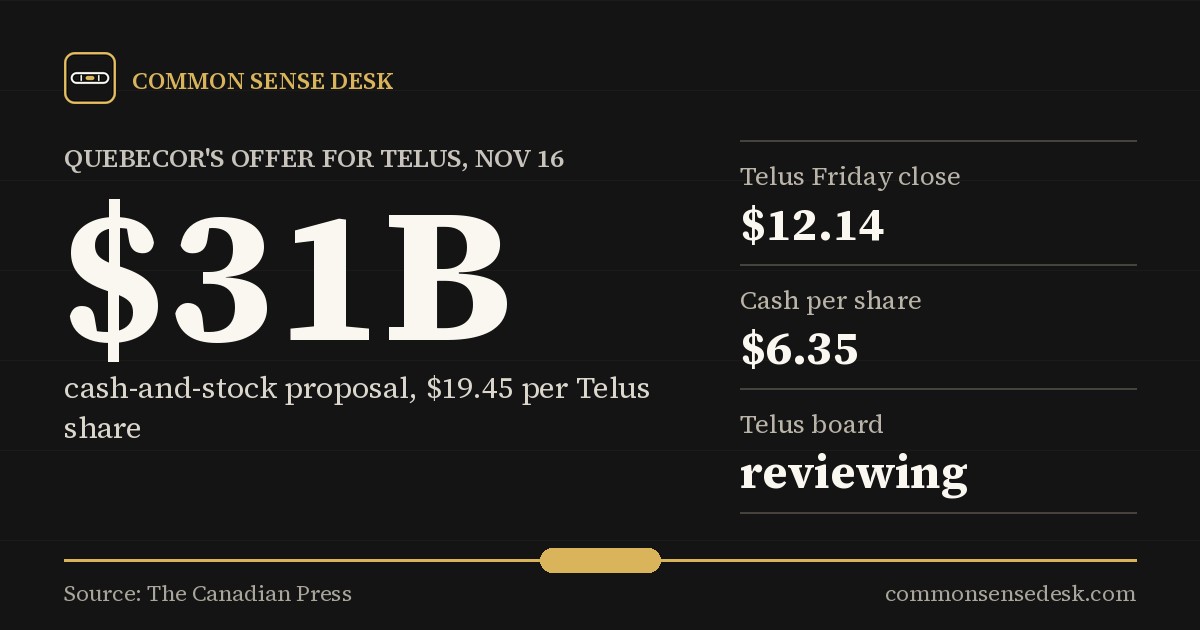
- Each Telus share would get $6.35 in cash plus 0.17 of a Quebecor class B share.
- Quebecor values that at $19.45 per Telus share, based on Friday's closing prices. Telus closed Friday at $12.14 on the Toronto Stock Exchange, so that's roughly 60% more.
- The total value is about $31 billion.
Quebecor says it first sent Telus a non-binding proposal on June 26, followed by an "enhanced proposal" on November 9, before going public. It argues the deal would combine complementary networks, wireless spectrum and operations to strengthen investment and competition.
What Telus says
Telus' board set up a special committee of independent directors to review the offer and is also looking at other options. Board chair John Manley said the review has surfaced "significant risks associated with Quebecor's proposal." He added: "Quebecor has yet to explain how what it is proposing could be approved under the current telecom regulatory framework."
Telus said it's willing to keep talking with Quebecor, its advisers and government and regulatory authorities.
Who's who
Quebecor is controlled by the Péladeau family and runs Videotron, the main cable, internet and wireless provider in Quebec, along with Freedom Mobile in the rest of the country. Telus is based in Vancouver and is one of Canada's three national carriers, with brands like Koodo and Public Mobile, plus large businesses outside telecom, including Telus Health. A combination would bring together Quebec's dominant regional player and a coast-to-coast national carrier.
What a deal would need
Even if Telus' board agreed, a deal like this would need several approvals: Telus shareholders would have to vote for it, the Competition Bureau would review whether it lessens competition, and Ottawa would have to approve transferring wireless spectrum licences. Each of those steps can take months, and any one of them could block it or demand big changes, like selling off customers or spectrum to another company.
Why regulators matter so much here
Canada's wireless market is dominated by three big companies: Rogers, Bell and Telus. For years, Ottawa's policy has been to encourage a strong fourth player to push prices down. Quebecor became that fourth player when it bought Freedom Mobile in 2023, as part of the deal that let Rogers buy Shaw.
A Quebecor-Telus combination would turn that picture upside down: instead of a fourth carrier challenging the big three, one of the big three would merge with the challenger. Quebecor says the combined company would be a stronger competitor. Critics will say it would mean fewer real choices. Competition authorities and the federal government would have to sign off, and Telus is openly doubtful they would.
What it means for your wallet
Canadians pay some of the highest phone bills in the developed world, and prices only started coming down in the last few years as Freedom Mobile and others competed harder. Interestingly, Statistics Canada's latest figures show cellular service prices fell 6.2% over the past year.
That's the heart of the matter for consumers. More competition has generally meant lower prices. Any deal that reduces the number of serious players has to convince regulators it won't undo that. If you're a Telus, Koodo, Freedom or Videotron customer, nothing changes now. This would take many months of review even if Telus agreed.
For investors, Telus shares jumped sharply on the news, according to market reports. If you hold Canadian dividend funds or a pension, there's a good chance you own some Telus, and some Quebecor.
A practical tip in the meantime: check your plan. Carriers have been competing hard on price, and switching or simply calling to ask for a better rate still saves many families real money every month.
What to watch next
- Whether Telus' board rejects the offer or opens talks.
- Any signal from Ottawa or the Competition Bureau.
- Whether Quebecor raises its bid or takes it directly to shareholders.
We may earn a commission from Amazon links on this page, at no extra cost to you. As an Amazon Associate, Common Sense Desk earns from qualifying purchases.
Sources
- The Canadian Press (via BNN Bloomberg): Quebecor makes cash-and-stock offer for Telus worth $31 billion bnnbloomberg.ca
- Statistics Canada: Consumer Price Index, October 2026 (cellular services) www150.statcan.gc.ca