

We may earn a commission from Amazon links on this page, at no extra cost to you. As an Amazon Associate, Common Sense Desk earns from qualifying purchases.
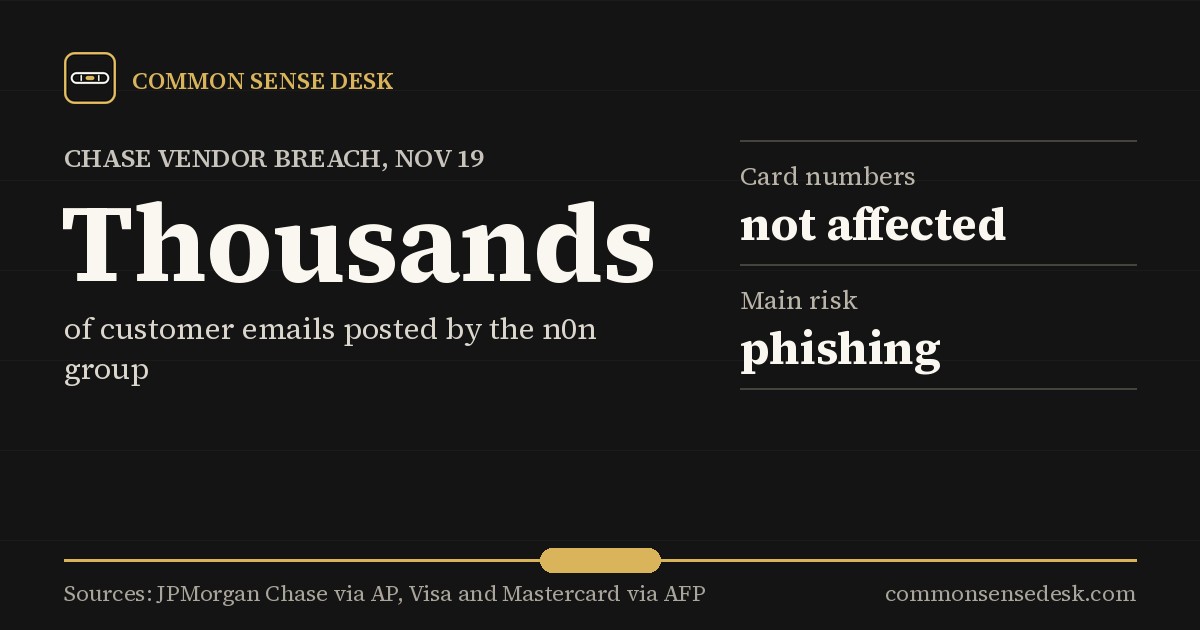
Hackers posted email addresses and some phone numbers belonging to thousands of JPMorgan Chase customers on Thursday, November 19, after the bank said attackers had broken into outside companies that handle its marketing. Visa and Mastercard said customers of theirs were caught up in similar attacks on their suppliers.
All three companies say no card numbers or payment data were taken. The bigger risk for customers right now is scam emails and texts that use the leaked details to look real.
What Chase says
"We have learned that third parties who provide services to the firm were the target of a cyber attack," Chase spokesman Joe Evangelisti said, according to the Associated Press. "Based on our investigation so far, we believe the attackers accessed certain marketing data held by those vendors."
Chase said none of its own services were affected. It also said the incident was unrelated to the software bug that disrupted some Chase banking services, including Zelle payments, earlier in the week. We covered that outage in our Chase outage story.
The bank hasn't named the vendors or said exactly how many customers were affected.
What leaked
According to AP, the leaked files were mostly email addresses of Chase customers and some bank employees, with phone numbers in some cases. The affected accounts number in the thousands, AP reported, a small fraction of Chase's tens of millions of customers. Euronews, citing reports on the files, put the total across Chase, Visa and Mastercard at about 16,000 customers and said some Chase account ID numbers were included. Chase hasn't confirmed that figure.
AP said the data did not include credit card numbers or especially sensitive personal information. None of the reports mention passwords or Social Security numbers.
Visa and Mastercard
Visa said the claims involved a supplier based in the Asia-Pacific region. "Visa's systems were not involved and were not impacted. No payments data such as card numbers were affected," the company said, according to Euronews.
Mastercard said an attack on a provider "resulted in the exposure of limited amount of non-payments information from a subset of cardholders." Mastercard spokesman Seth Eisen told AP, "At this time, the exposure has been contained," and said the company was working with the provider to support affected cardholders.
Who's behind it
A criminal group calling itself n0n claimed responsibility. On Monday it listed dozens of organizations on its leak website and gave Visa and JPMorgan Chase 48 hours to negotiate before it would publish data. We reported on those claims in our story on this week's outages and the n0n claims. When the deadline passed, the group posted the files.
The cybersecurity firm SOCRadar told AFP the group appears to come from Russia, first surfaced in September, and claims to have hit nearly 200 companies worldwide. SOCRadar said it couldn't verify all of the group's claims.
This kind of attack is becoming common. Instead of breaking into a big bank directly, hackers go after smaller companies that hold some of its data, such as marketing or email firms, which often have weaker defenses.
What you should do
If you're a Chase, Visa or Mastercard customer, there's no sign your money or card numbers are at risk from this leak. The practical danger is phishing. Someone who has your name, email and the fact that you bank with Chase can send a very convincing fake message.
- Don't click links in emails or texts that say there's a problem with your Chase account, even if they use your name. Open the Chase app or type chase.com yourself.
- Chase won't ask for your password, full card number or one-time codes by email, text or phone. Anyone who does is a scammer.
- Be wary of calls claiming to be Chase's fraud department. Hang up and call the number on the back of your card.
- Turn on two-step verification for your bank and email accounts. A hardware security key is one of the strongest options for email accounts that support it.
- Check your statements, and consider a free credit freeze with Equifax, Experian and TransUnion if you're worried. It's free and doesn't affect your credit score.
If Chase determines your data was involved, the bank is expected to contact you directly. Treat any message that claims to be that notice with the same care, and confirm it through the app.
What to watch
Whether Chase confirms how many customers were affected and names the vendors, whether more of the 59 organizations n0n listed this week see their data posted, and whether U.S. law enforcement announces an investigation. No regulator or police statement had been made public as of Friday.
Sources
- AP (via Boston Globe): A cyberattack leaks thousands of Chase customer emails and some phone numbers (Nov. 19, 2026) bostonglobe.com
- Euronews/AFP: Hackers leak stolen data on Visa, Mastercard and JPMorgan customers (Nov. 20, 2026) euronews.com