

We may earn a commission from Amazon links on this page, at no extra cost to you. As an Amazon Associate, Common Sense Desk earns from qualifying purchases.
If a Zelle payment or a transfer got stuck on Monday, you weren't alone. A software bug at JPMorgan Chase, the biggest bank in the U.S., slowed down transactions on Monday, November 16. Some of that spilled over to customers at other banks who were sending money to or from Chase, including some Zelle payments.
Chase says it wasn't a cyberattack, and that transactions were posting normally again by Monday evening. Here's what happened, who was affected, and what to check in your own accounts.
What happened
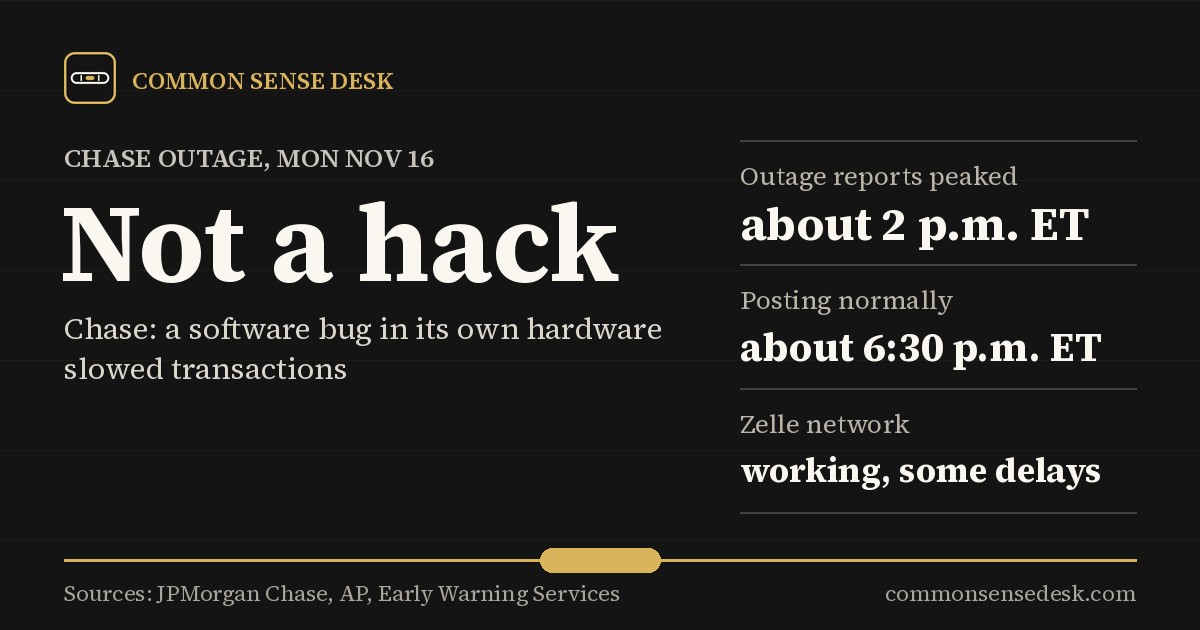
Thousands of people reported trouble reaching their online bank accounts on Monday, according to the Associated Press. Reports on Downdetector, a site that tracks outage complaints, peaked around 2 p.m. Eastern Time and then dropped off later in the day, according to Al Jazeera.
Some Chase customers who tried to log in saw this message: "Some services aren't available. We're working on them. Please try back later."
Chase spokesman Joe Evangelisti said the bank "has experienced a temporary issue related to a software bug in an on-premise hardware system." In plain words, the problem was in Chase's own equipment, not out on the internet. He added that it "is not cyber-related."
He also said, "This is not a systemic issue." Other banks were only slowed down when Chase was on the other end of a transaction.
Shortly after the close of business, around 6:30 p.m. ET, a Chase spokesperson said transactions were "posting normally" again. That means the system was working again. It doesn't necessarily mean every payment that got held up during the day had already gone through.
Was Zelle down?
No, according to the company that runs it. Zelle is operated by Early Warning Services, which is owned by a group of big banks. A spokesman said the Zelle network itself was fully working. "Zelle is not down. Zelle is operating as it should," Early Warning said.
The catch is that Zelle runs through your bank. If your bank, or the other person's bank, is having trouble, the payment can still be delayed even though Zelle itself is fine. A spokesman said, "An issue at the financial institutions may be delaying Zelle payments for some of their customers."
What other banks said
- U.S. Bank: its own systems weren't directly affected, but customers sending or receiving Zelle payments with another bank "may experience transaction delays."
- Bank of America and Citigroup: said their banking services weren't having problems.
- Capital One and Truist: said their services were running normally, according to Al Jazeera.
Some customers at those banks still reported problems on outage sites. That fits with what Chase described: if you were sending money to a Chase account, or getting money from one, your payment could have been slowed even if your own bank was fine.
A rough week for big systems
Monday's bank trouble came after several other big outages in a short time. Microsoft had a worldwide Outlook and Teams outage that started Thursday, November 12. On Friday, November 13, the FAA briefly stopped flights nationwide because of a telecommunications problem. United Airlines also said it fixed an internal system outage on Monday.
So far, nothing links these together. Microsoft called its outage a technical problem, the FAA pointed to old equipment and network trouble, and Chase says its problem was a software bug in its own hardware. Some posts online have tried to tie them all together as signs of something bigger. There's no evidence of that.
What it means for your wallet
- Check your recent payments. If you sent or expected money on Monday, look at your account and make sure it went through. Most delayed payments should post on their own once the bank catches up.
- Don't send the same payment twice right away. If a payment shows as pending, give it some time. Sending it again could mean paying twice, and Zelle payments are hard to get back.
- Watch for late fees. If a bill payment, rent or a loan payment was due Monday and got held up, call the company or your bank. Many will waive a late fee when the bank's own system caused the delay, but you usually have to ask.
- Be careful with "fix your account" messages. Scammers love outages. Chase and other banks won't text or call asking for your password or a one-time code. If you're unsure, call the number on the back of your card.
- Keep a little backup. A bit of cash at home, or a second way to pay, helps on days like this. So does a charged power bank if you rely on your phone for banking.
What to watch next
Chase hasn't said how many customers were affected or exactly how long the problem lasted. Banks that have big outages sometimes face questions from regulators, but no regulator had commented as of Tuesday morning. If you're still missing money from Monday, contact your bank directly and keep a note of the date, time and amount.
Sources
- Associated Press (via Tech Xplore): A technical issue at JPMorgan Chase triggers online banking delays for major US banks techxplore.com
- Al Jazeera: US bank outage: What caused Chase problems and Zelle payment delays? aljazeera.com
- ABC News: JPMorgan Chase reporting technical issue, delays with transactions abcnews.go.com