

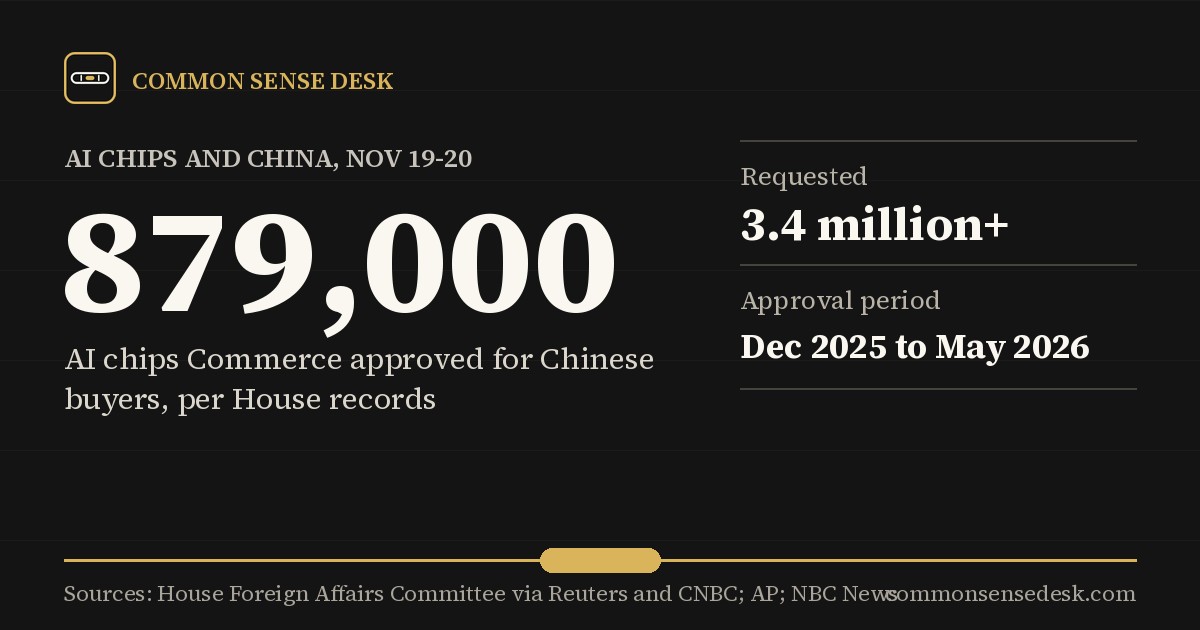
Two separate fights over artificial intelligence and China came to a head this week. On Thursday, November 19, a House committee released government records showing the Commerce Department approved the sale of about 879,000 advanced AI chips to Chinese companies, including some the Pentagon lists as linked to China's military. A day later, President Trump threatened "a tremendous tax" on American companies that build AI data centers in other countries.
The chip approvals
The House Foreign Affairs Committee, led by Rep. Brian Mast, a Florida Republican, released export license records from the Commerce Department's Bureau of Industry and Security. According to Reuters and CNBC:
- Between December 2025 and May 2026, Commerce approved licenses for about 879,000 high-end AI chips for Chinese buyers, mainly Nvidia's H200 and a comparable AMD chip.
- Companies had asked for more than 3.4 million. A Bernstein analyst told CNBC that Commerce "approved about one out of every four."
- Approvals included 150,000 chips for Tencent, 75,000 for Alibaba, 43,000 for Baidu and 4,000 for carmaker BYD, all companies on the Pentagon's list of alleged Chinese military companies, Reuters reported.
It isn't clear how many of the approved chips were actually shipped. Nvidia said that "despite receiving some licenses, we have since stopped shipping H200s to China," and that its approvals were "subject to strict conditions and limited volumes."
Mast called the release "the most detailed public disclosure in the history of the Export Control Reform Act." He also raised concerns about two buyers he called suspected "smuggling fronts," saying: "If BIS approved the sale of these chips to these firms, obviously that is of tremendous concern to us," CNBC reported. Those companies didn't respond to requests for comment.
Democrats were critical too. "The Bureau of Industry and Security has failed to enforce the rules," said Rep. Gregory Meeks of New York, the committee's top Democrat. "The public has the right to know how these decisions were made."
Commerce's side
The Commerce Department said its approach was based on a rule published in January 2026 allowing some sales under conditions, Reuters reported. A spokesperson for the Bureau of Industry and Security told CNBC that "licensing decisions are the product of deliberation and consultation among multiple U.S. Government agencies," and said the bureau had shared its approval and denial information with Congress. AMD said it "complies with applicable U.S. export control laws and regulations."
The administration has argued that letting U.S. companies sell some chips to China keeps American technology at the center of the global AI industry, while blocking the most advanced chips. Critics say any high-end chip that reaches Chinese military-linked firms is a security risk.
The fight over Nvidia's China sales has been building for weeks. Treasury Secretary Scott Bessent has blamed Commerce for the problem, which we covered in our Bessent and Lutnick story, and Congress has called Commerce Secretary Howard Lutnick and former Nvidia CEO Jensen Huang to testify.
The data center tax threat
At a White House press conference on Friday, Trump said: "We're not going to allow companies to build data centers in other countries. If they do that, they can. But we're going to put a tremendous tax on them," according to AP. He linked it to China: "They allowed that to happen with chips and everything else, and it was very destructive to our country," NBC News reported.
He gave no tax rate, no timeline and no legal basis. Under the Constitution, new taxes generally need Congress. Trump also said, "I haven't even said that to my people," NBC reported. The White House didn't respond to requests for details.
The threat comes as data centers have become a political issue at home. About three-quarters of voters opposed a new data center in their own community, according to AP's survey of voters in this month's midterms, largely over electricity prices and water use. Trump has praised a permitting reform bill the Senate passed on Thursday, which would make data centers pay for the power and grid upgrades they use; we covered an earlier Senate vote in our permitting story.
Tech stocks fell sharply on Friday, NBC reported, though it's hard to tie that to one remark.
What it means for you
Neither development changes much for ordinary users today. But both affect the stock prices of a few huge companies, Nvidia, AMD, Microsoft, Google, Amazon and Meta, that make up a large share of most retirement funds. If you hold an S&P 500 index fund, these debates show up in your balance, which is a reason to stay diversified rather than chase one stock.
And where data centers get built affects local power bills. A push to build more in the U.S. means more pressure on American grids, which is why the question of who pays for new power lines matters.
What to watch
Whether Commerce changes its licensing, whether Congress moves an export control bill, Huang's closed-door interview with the committee set for December 1, and whether the White House puts any detail behind the data center tax threat.
Sources
- Reuters (via Yahoo): US signed off on sales of nearly 900,000 AI chips to China, House committee says (Nov. 19, 2026) yahoo.com
- CNBC: Commerce approved sales of more than 879,000 AI chips to Chinese companies, Rep. Mast says (Nov. 19, 2026) cnbc.com
- AP (via Yahoo): Trump threatens tax on US companies building AI data centers overseas (Nov. 20, 2026) yahoo.com
- NBC News: Trump threatens companies that build AI data centers overseas (Nov. 20, 2026) nbcnews.com