

We may earn a commission from Amazon links on this page, at no extra cost to you. As an Amazon Associate, Common Sense Desk earns from qualifying purchases.
The Federal Reserve is getting ready to raise interest rates again. Minutes from its October meeting, released Wednesday, November 18, show that "almost all participants" thought more rate hikes would likely be needed. Hours earlier, Fed Governor Christopher Waller said the Fed might have to move faster than people expect.
The next decision comes December 9. Markets now treat a hike as close to certain. That would be a sharp turn for a central bank that was cutting rates as recently as late last year.
What the minutes say
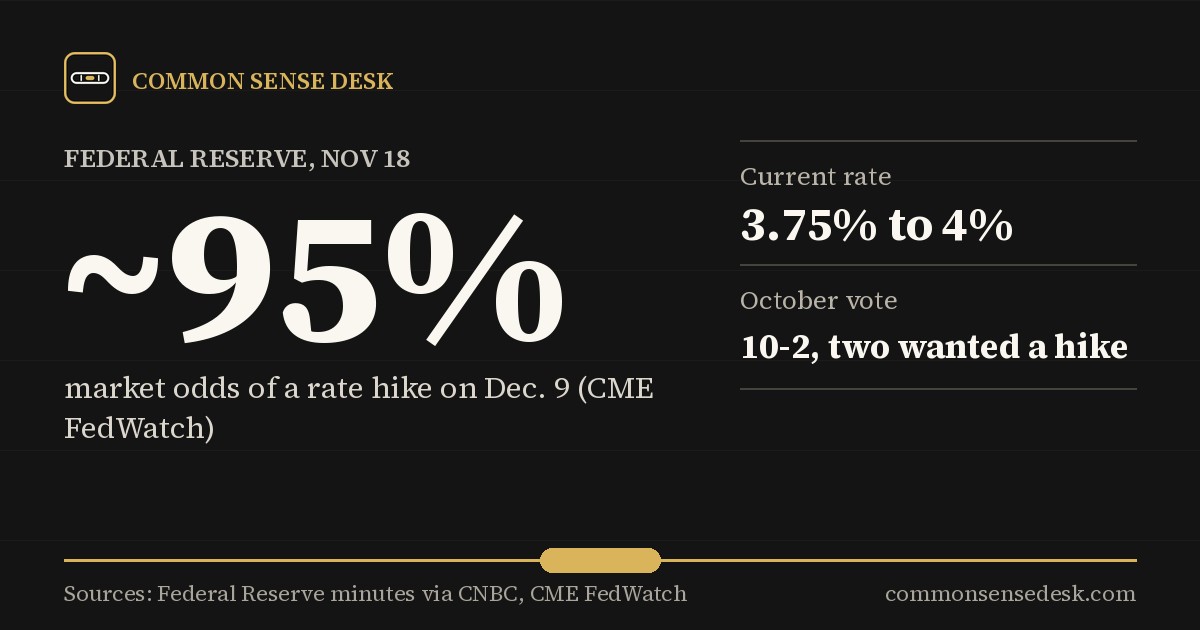
At the October 27-28 meeting, the Fed kept its key rate at 3.75% to 4%. The vote was 10-2. Governor Lisa Cook and Cleveland Fed President Beth Hammack both voted against holding, because they wanted a quarter-point hike right away.
The minutes show most of the rest of the committee wasn't far behind. According to the minutes, as reported by CNBC:
- "Almost all participants judged that, under their baseline outlooks for inflation and the labor market," further increases would likely be appropriate.
- Some officials wanted a hike in October, and a couple said a bigger-than-usual increase might be needed in December.
- Officials said "inflation pressures in the economy were broad based," meaning prices are rising across many kinds of goods and services, not just a few.
The minutes also show real worry about artificial intelligence. Officials called AI-related spending "a material source of inflation risk." Fed staff warned that some of the ways AI companies are financing their growth, including leasing deals kept off their balance sheets and money moving in circles between related firms, could make losses worse if things go wrong. Most participants said a lot of the new AI-related debt runs through "complex and opaque financing structures."
What Waller said
Waller, a Fed governor, went further in a CNBC interview Wednesday morning. "I'm very, very concerned about inflation," he said. "It's kind of headed in the wrong direction, and it's spreading out."
"If you really want to get it down, you've got to start taking more aggressive actions," he said, adding: "You might need to, like, shock people." He has floated a half-point hike in December if inflation keeps running hot, instead of the usual quarter point.
Why the Fed is worried
Inflation picked up again this year, pushed by fuel prices from the Iran war and heavy spending on AI data centers. The consumer price index rose 0.4% in October, and 0.3% without food and energy, both a bit hotter than expected. We covered the earlier inflation picture in our inflation story.
Traders put the odds of a quarter-point hike on December 9 at about 95%, according to CME FedWatch, as reported by CNBC. Futures also point to a good chance of two more hikes in 2027. The 10-year Treasury yield, which helps set mortgage rates, was around 5.06% on Wednesday.
What it means for your money
Credit cards: Most card rates move with the Fed's rate, usually within a billing cycle or two. A quarter-point hike adds about $2.50 a year in interest for every $1,000 you carry on a card. If you have a balance, paying it down or moving it to a lower-rate option matters more now.
Mortgages: Fixed mortgage rates follow longer-term bond yields more than the Fed's rate directly, and those yields are already high. If you're shopping for a home, rates may not jump overnight in December, but they're unlikely to fall soon either. Adjustable-rate mortgages and home equity lines of credit react more directly to Fed hikes.
Car loans: New auto loans tend to get a little more expensive after hikes. Shopping around between your bank, a credit union and the dealer can still save real money.
Savings: This is the one upside. High-yield savings accounts and CDs usually pay more after a hike. If your savings are sitting in an account paying close to nothing, it's worth comparing.
For a plain guide to handling debt and saving when rates are rising, The Total Money Makeover and I Will Teach You to Be Rich are two popular, practical picks.
What to watch
- More inflation and jobs data before December 9.
- Whether other Fed officials join Waller in talking about a half-point hike.
- The December 9 decision itself, and the Fed's new forecasts for 2027.
Sources
- CNBC: Fed officials expect more rate hikes, worry about AI impact on inflation, minutes show (Nov. 18, 2026) cnbc.com
- CNBC: 2-year Treasury yield little changed as Waller warns Fed may need to 'shock people' (Nov. 18, 2026) cnbc.com
- Federal Reserve: FOMC calendars and minutes federalreserve.gov