

We may earn a commission from Amazon links on this page, at no extra cost to you. As an Amazon Associate, Common Sense Desk earns from qualifying purchases.
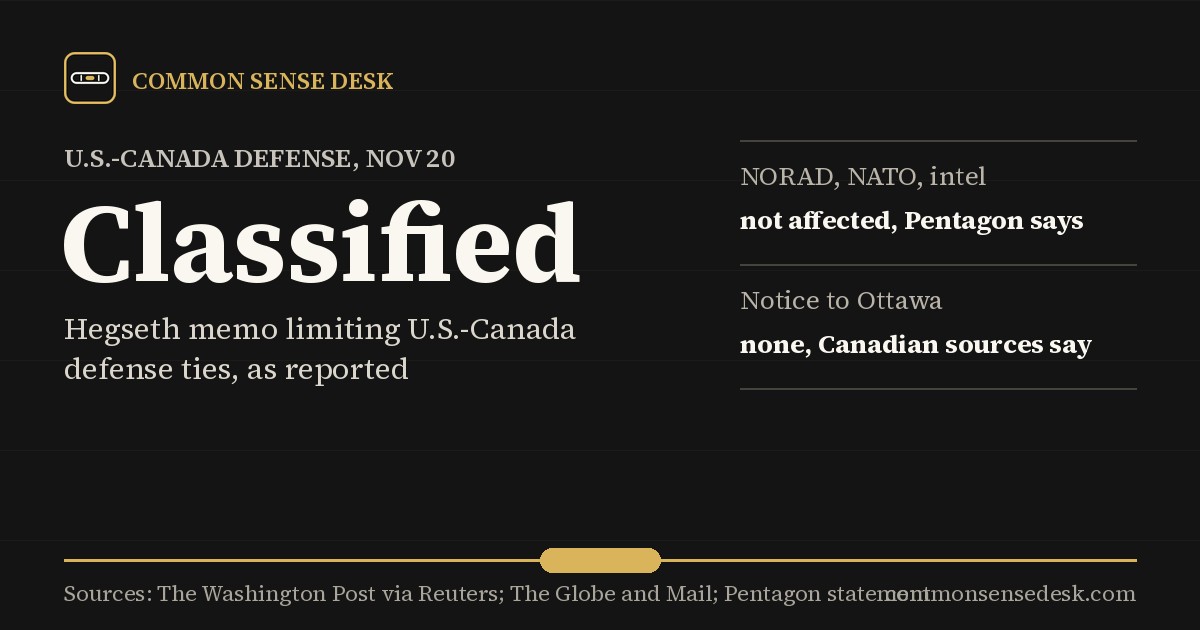
Defense Secretary Pete Hegseth has put new limits on how the U.S. military works with Canada, according to a report in The Washington Post on Friday, November 20. The Post said the order came in a classified memo that went out the week before, citing officials familiar with it.
The memo hasn't been made public. The Post said it had not seen the document itself, and nobody has said on the record which programs or activities are affected. So this is a reported story, not a published order, and the details may change as more comes out.
What the Pentagon says
The Pentagon didn't deny the memo exists. Its chief spokesman, Sean Parnell, said in an emailed statement on Friday evening that the department "is taking steps to ensure its engagements with Canada advance tangible U.S. defense objectives."
He also drew a line around three things. "This guidance does not impact defense intelligence cooperation, our binational NORAD command, or our cooperation through NATO," Parnell said. He added that the department is prioritizing bilateral cooperation that "strengthens the defense of our Homelands and shared hemisphere, while supporting Canada's ability to meet NATO obligations."
That matters because NORAD is the big one. The North American Aerospace Defense Command is run jointly by both countries and watches the skies over the whole continent for missiles, aircraft and anything else heading our way. It's the reason a Canadian officer can be on duty in Colorado tracking a plane over Alaska. If the Pentagon's statement holds, that work goes on as before.
What isn't known
Quite a lot. Reports so far raise questions about joint exercises, training, exchange programs and defense planning, but there's no confirmation that any of those have actually been cut.
The Globe and Mail spoke with three Canadian military sources and a senior government source. They said Ottawa received no communication from Washington about the memo, "formally or informally." Senior leaders of the Canadian Armed Forces weren't aware of it and learned about it from the Post's story, the sources said.
Two senior military sources told the Globe that all military-to-military relationships are "currently operating normally" and Canada plans to stay the course. They said it was hard to tell what would be affected, and pointed to exchange programs, where officers from one country serve inside the other's military, as one possibility.
The Prime Minister's Office, the Defence Minister's office and the office of the minister for Canada-U.S. trade all declined to comment, the Globe reported.
One line has been widely quoted. A U.S. official told the Post that Canadian officials would likely see the restrictions as a "slap in the face." That was an American official predicting the reaction, not a Canadian speaking.
Intelligence sharing was the other worry. An official from another Five Eyes country, the intelligence alliance of the U.S., Canada, the U.K., Australia and New Zealand, told the Post there was "no formal indication" that sharing arrangements would change. That official also said U.S. agencies had shared less information across several channels over the past year.
How we got here
This didn't come out of nowhere. Defense ties have been strained for most of the year, alongside the trade fight.
In May, the U.S. suspended its participation in the Permanent Joint Board on Defense, a U.S.-Canada body that dates back to 1940. Pentagon officials have said Canada isn't moving fast enough on defense spending. Elbridge Colby, the undersecretary of defense for policy, wrote that "Canada has failed to make credible progress on its defence commitments," and a U.S. official told Canadian reporters at a Pentagon briefing that Ottawa had no concrete plan to reach 5% of GDP by 2035, the Globe reported.
Ottawa calls that unfair. Canada says it has reached NATO's 2% target and has committed to the new 5% goal by 2035 that NATO members agreed on.
The Globe also points to American frustration over Canada's review of its F-35 purchase. Ottawa ordered that review of the 88-jet deal after President Trump floated making Canada the "51st state" and put tariffs on Canadian goods.
And then there's trade. Tariffs on Canadian autos and steel are set to rise to 50% on January 1 unless a deal is reached, which we covered in our story on Canada's shift to seeking the "lowest rate". On Friday, Trump said of Canada, "For some reason they feel emboldened. We can't let them feel that way anymore."
What it means for Canada and for you
For now, probably not much you'd notice. The parts of the relationship that most directly protect people on both sides of the border, NORAD's air and missile watch and intelligence sharing, are the parts the Pentagon says are untouched.
What could change is quieter: fewer joint exercises, fewer Canadian officers serving in U.S. units and the other way around, slower defense planning. Those things don't make headlines, but they're how two militaries learn to work together before an emergency, not during one.
For Canadians, there's also a money angle. Pressure from Washington is one reason Ottawa is raising defense spending fast, and getting to 5% of GDP would mean tens of billions more a year. That money comes out of the same federal budget as everything else, so it's a fair question for voters how it gets paid for.
For Americans, the main thing is that North American air defense is a shared job. Radars and fighter bases in Canada are part of how the U.S. homeland is defended, which is likely why NORAD was the first thing the Pentagon said it was protecting.
If you want background on how Canada's military got where it is today, J.L. Granatstein's Canada's Army: Waging War and Keeping the Peace is a readable history, and Paul Kennedy's The Rise and Fall of the Great Powers is a classic on how alliances and military spending shape countries over time.
What to watch
- Whether the Pentagon or Ottawa says on the record which programs are affected.
- Any response from Prime Minister Mark Carney or Defence Minister David McGuinty.
- Upcoming joint exercises and officer exchanges, and whether any are quietly cancelled.
- The Canada-U.S. trade talks before the January 1 tariff increase.
We'll add an update if the memo's contents become public or either government says more.
Sources
- Reuters (via Yahoo): US Defense Secretary Hegseth restricts military ties with Canada, Washington Post reports (Nov. 20, 2026) yahoo.com
- The Globe and Mail: No change to Canada-U.S. defence co-operation, military sources say amid report of new restrictions by Washington (Nov. 2026) theglobeandmail.com
- Newsmax Wires (via Yahoo): Hegseth Secret Memo Restricts US-Canada Military Ties, incl. Pentagon statement by Sean Parnell (Nov. 20, 2026) yahoo.com