

You find a house online that looks perfect. Bright rooms, green lawn, a fireplace in the living room. Then you drive over for the showing and the lawn is dirt, the rooms are dark and the fireplace isn't there. There's now a name for that: "housefishing." It's a play on catfishing, and it means listing photos edited, often with AI tools, so a home looks a lot better online than it does in real life.
It's not a rare thing anymore. And for most families a house is the biggest purchase they'll ever make, so it's worth knowing where the line is and how to protect yourself.
How common is it?
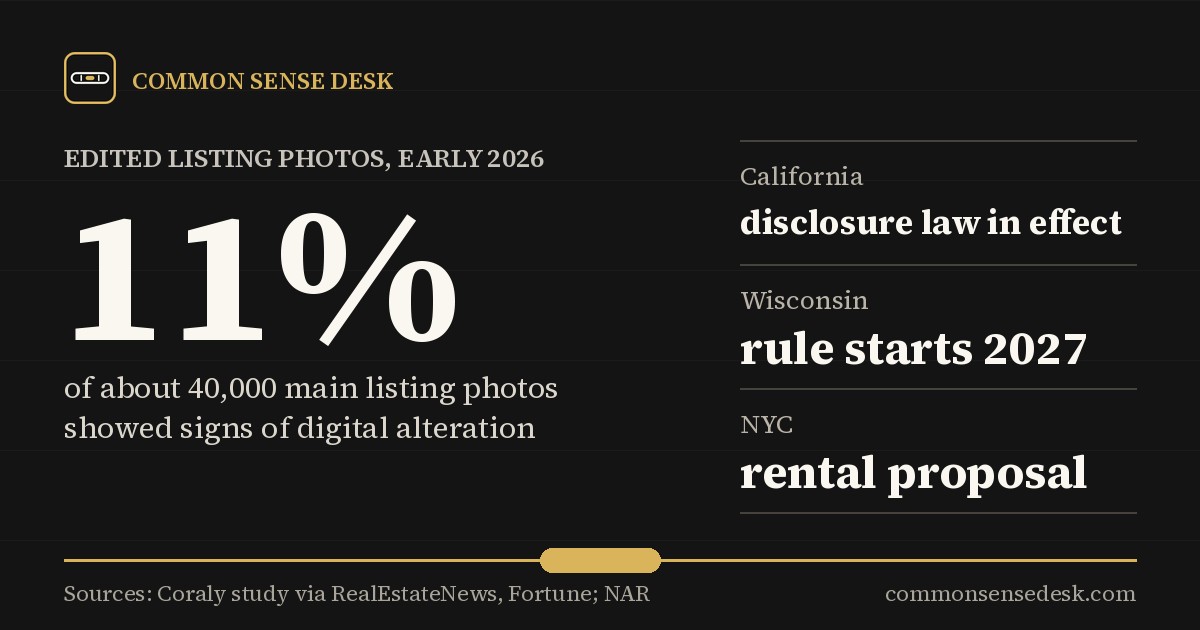
A study by the real estate photo company Coraly looked at about 40,000 main listing photos on Zillow, Redfin, Realtor.com and Homes.com in the first three months of 2026. Nearly 11% showed signs of digital alteration, according to RealEstateNews and Fortune. That's roughly one in nine.
Not all of that is cheating. Real estate photos have always been touched up: brighter lighting, a bluer sky, a straightened picture. The problem is that new AI tools make it easy, cheap and fast to do much more than that. They can repaint walls, add a lawn, swap light fixtures, smooth out cracks, or make a cramped room look twice its size.
Complaints that have made the news include a fireplace that didn't exist, different light fixtures from the ones in the house, and a rental apartment that looked big and bright online but was small and dark in person, according to RealEstateNews.
Where's the line?
Here's a plain way to think about it. Editing that makes a photo look good is normal. Editing that changes what you'd actually be buying is misleading.
- Usually fine: fixing the lighting and color, straightening the angle, cleaning up glare.
- Fine if it's labeled: "virtual staging," where furniture is added to an empty room to show how it could look. Zillow says its own virtual staging is labeled and shown next to the original photo.
- Misleading: hiding damage, adding features that aren't there, changing the view out the window, making rooms look bigger, or covering up things like power lines or a busy road next door.
The National Association of Realtors' Code of Ethics already tells its members to "refrain from exaggerating, misrepresenting or concealing pertinent facts" and to present a "true picture" in their ads. In a post this August, the group said AI should be used to "show possibilities" in a home, "not rewrite reality," according to RealEstateNews.
Zillow says its standards "require that listing photos accurately represent the home," and that it supports clear disclosure when AI is used to materially change a photo.
What the law says
This is new territory, and the rules depend on where you live:
- California: A state law that took effect in January, Assembly Bill 723, requires real estate agents and brokers to disclose "digitally altered images" in their ads and to give a public link to the original, unedited photo.
- Wisconsin: A new law takes effect at the start of 2027. Agents will have to disclose when technology materially changes how a property looks in marketing photos.
- New York: The state's Department of State warned buyers late last year to watch for AI images in listings. In New York City, Mayor Zohran Mamdani proposed in July that landlords, brokers and listing sites disclose AI-altered photos and videos in rental listings. It's a proposal, not law yet.
- New Jersey: Lawmakers are considering a bill on deceptive AI listing images.
Even where there's no specific AI law, misleading ads can still run into state consumer protection and false advertising rules. A buyers' agents group, NAEBA, has warned that altered images giving a false picture of a home's condition can raise false advertising concerns.
How to spot it
You don't need special software. Mostly you need to slow down and look closely:
- Look for labels like "digitally altered," "virtually staged" or "AI-enhanced," and ask to see the originals.
- Check for strange details. New York's Department of State tells buyers to watch for "distorted or inconsistent details," like blurry backgrounds or window views that don't match.
- Compare photos with each other. If the floor or wall color changes from one shot to the next, something was edited.
- Use the street view on a map app to see the outside, the yard and the neighbors as they really are.
- Ask for a video walk-through if you can't visit in person, ideally live.
- If it looks too perfect, it probably is. Real houses have scuffs.
What it means for your wallet
The real cost of housefishing isn't just a wasted Saturday. It can push you to bid more for a home than it's worth, or to sign a lease before you've seen the place. Every showing also costs you time, gas and sometimes a day off work.
The common-sense rules haven't changed. Never buy or rent anything you haven't seen in person or on a live video. Get a proper home inspection before you close; it's the one check photos can't fake. And if you find out a listing was badly misleading, keep screenshots and tell your agent, the listing site and, if needed, your state real estate licensing office.
Most agents play it straight, and a good photo of a real house is fair game. The point is simple: you deserve to know what you're actually paying for.
Sources
- RealEstateNews: AI-modified listing photos blur line between enhancement, deception realestatenews.com
- Fortune: NYC proposes AI disclosure rules for rental listing photos fortune.com
- National Association of Realtors: Code of Ethics nar.realtor