

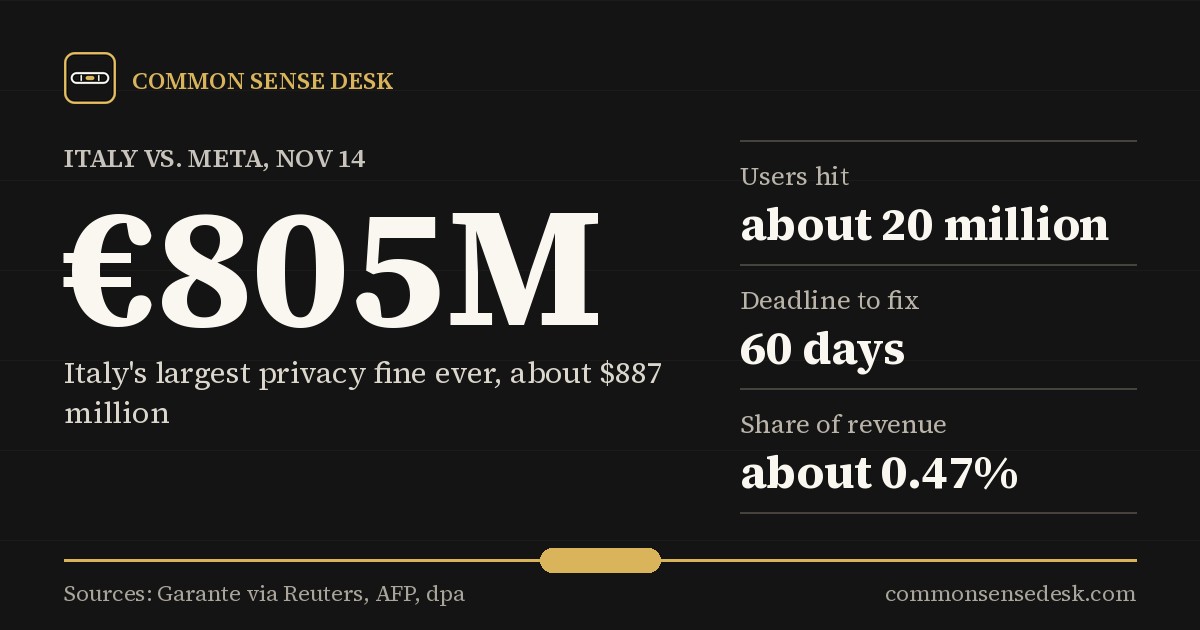
Italy's privacy regulator has fined Meta €805 million, about $887 million, saying the Facebook app on Android phones dug into people's photo galleries without proper permission. It's the biggest fine the Italian regulator has ever handed out, according to Al Jazeera, citing Reuters and AFP.
If you use Facebook on your phone, this is worth five minutes of your time, because the same kind of setting is probably on your phone right now.
What the regulator says Meta did
The fine comes from Italy's data protection authority, known as the Garante. It's about a Facebook feature, available since 2023, called "Get suggestions from gallery when browsing Facebook." The idea is simple: Facebook looks at the photos and videos on your phone and suggests some you might want to post.
The problem, according to the regulator:
- The app accessed photos, videos and their metadata, the hidden details like when and where a photo was taken, "without specific consent and without informing" users, the Garante said, according to Al Jazeera.
- A single general permission covered several functions in the app and gave access to the entire photo archive, in most cases permanently, the German news agency dpa reported.
- The feature was switched on by default, so people didn't have to choose it.
- The regulator called Meta's consent notices "too generic" and also cited a "lack of cooperation" by the company.
About 20 million Android users in Italy were affected, the regulator said. It said this broke Italy's law implementing the European Union's ePrivacy rules.
The investigation started in July 2025 after a tip from a consumer protection center in Bolzano, in northern Italy, according to dpa. The Garante also said an earlier violation, which led to a fine in 2019, counted against Meta this time.
What Meta has to do
Meta has 60 days to get users' explicit consent before accessing their photo galleries, dpa reported. It also has to switch the feature off by default, including for people who already gave the app general access.
The fine works out to about 0.47% of Meta's worldwide revenue for 2024, according to the regulator. For a company that size it's not a fatal blow, but it's a clear message, and the order to change how the feature works may matter more than the money.
Meta's side
Meta hadn't commented publicly on the fine as of Saturday, according to Al Jazeera. It can appeal.
During the case, Meta argued that Ireland's data protection authority should handle it, since Meta's European headquarters are in Dublin. Under EU rules, the regulator in a company's home country usually takes the lead on many privacy cases. The Italian regulator rejected that argument. That fight over who gets to decide could be part of any appeal.
It's also worth being clear about what this case is not about. It didn't deal with whether photos were used to train artificial intelligence, which Meta denies, according to the reports.
Why it matters beyond Italy
This is a European ruling, and it only covers Italy. Americans and Canadians don't get a refund or any direct change from it. But big tech companies often change a feature worldwide rather than run different versions country by country, so rulings like this can end up shaping what everyone sees.
And the basic issue applies to everyone: apps often ask for broad access to your photos once, and then keep it. Most people tap "Allow" and never think about it again.
What it means for you: check your photo settings
This takes a couple of minutes and costs nothing:
- On Android: go to Settings, then Apps, pick Facebook (or any app), then Permissions, then Photos and videos. Newer Android versions let you choose "Allow limited access" to pick specific photos instead of the whole gallery, or "Don't allow."
- On iPhone: go to Settings, then Privacy & Security, then Photos. For each app you can choose limited access, full access or none.
- Inside Facebook: look in the app's settings for camera roll or gallery suggestions, and turn them off if you don't use them.
- Do the same for other apps. Shopping, social media and photo-editing apps are common ones with full gallery access they don't really need.
A good rule: give an app only the photos it needs, when it needs them. If an app works fine with limited access, there's no reason to hand it your whole camera roll, including pictures of your kids, your documents and your home.
What to watch next
- Whether Meta appeals, and whether the fight over Ireland vs. Italy goes to court.
- Whether Meta changes the feature across Europe or worldwide.
- Other EU regulators looking at similar features.
Sources
- Al Jazeera (with Reuters, AFP): Italy fines Meta over photo privacy aljazeera.com
- dpa (via Yahoo Finance): Italy fines Meta 805 million euros over Android app's photo access finance.yahoo.com