

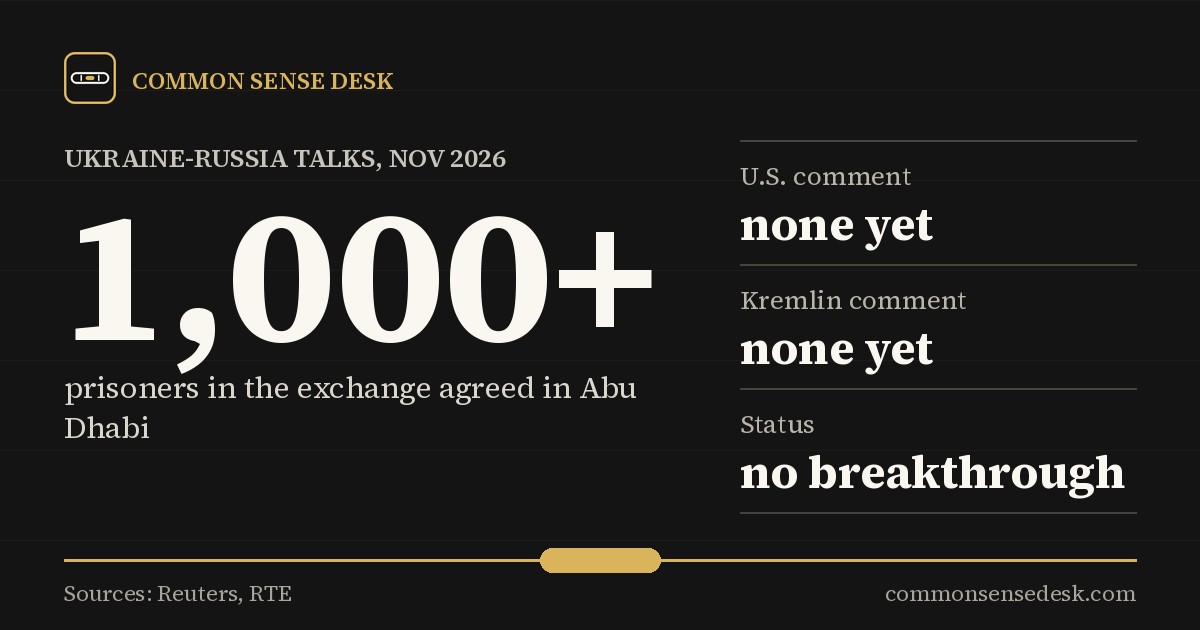
Ukrainian President Volodymyr Zelensky says U.S. negotiators raised a new idea in the latest peace talks: what if Ukraine joined NATO, and in return pulled out of the Donbas region in the east? That's his account. As of Saturday, there was no public confirmation from Washington and no Kremlin response to it, according to Reuters.
It's a big claim, because it touches the two things that have blocked a deal from the start: land and NATO. Here's what was said, what each side has said it wants, and why it matters.
What Zelensky says happened
In remarks to reporters released by his office, Zelensky described the question this way: "The Americans raised a question: 'What if Ukraine joins NATO? Would Ukraine withdraw from Donbas?'" according to Reuters and Ireland's public broadcaster RTÉ.
He said it was the first time NATO membership had been linked to giving up territory in the talks with Russia in Abu Dhabi.
Zelensky said Ukraine is not ready to give up territory. He said that if Ukraine got a full package, including security guarantees, a strong and funded army and money to rebuild, he would put it to the public in a national referendum. He said he has "no right to make that decision on my own."
Again: this is one side's description of a private conversation. We'll update this story if the White House, the State Department or the Kremlin responds.
What Donbas is, in plain words
Donbas is the industrial and coal-mining heartland of eastern Ukraine, made up of two regions, Donetsk and Luhansk. It borders Russia, and many people there speak Russian. Fighting there goes back to 2014, long before Russia's full-scale invasion in February 2022. Russia controls most of it today, but not all of it. Ukraine still holds a part of Donetsk, including several cities.
Russia announced in 2022 that it was annexing Donetsk and Luhansk, along with two southern regions, Zaporizhzhia and Kherson. Ukraine and most of the world don't recognize that.
What Russia has said it wants
President Vladimir Putin laid out his conditions publicly in June 2024: Ukraine would have to withdraw its forces from all four of those regions, and drop its bid to join NATO. Putin has long said Ukrainian NATO membership is a red line for Moscow, and he has cited it as one reason for the 2022 invasion, Reuters notes.
That's why the idea Zelensky describes is so striking. It would mean Ukraine leaving the rest of Donbas, which Moscow wants, while joining NATO, which Moscow has said it will never accept. There's no sign so far that Russia would agree to that trade.
Where the talks stand
Two days of U.S.-brokered talks between Ukraine and Russia in Abu Dhabi ended Wednesday without a major breakthrough, Reuters reported. We covered the start of those talks here.
There was one concrete result, and it's a human one: the two sides agreed to a prisoner exchange involving more than 1,000 people, with the final numbers still being worked out. For the families waiting on both sides, that matters more than anything else that came out of the room.
Since then, U.S. envoys Steve Witkoff and Jared Kushner were in Moscow, where they were expected to raise a ceasefire on energy targets with Putin, and then met Zelensky in Dublin on Thursday. No progress on an energy ceasefire was reported. Zelensky also said the U.S. told him Europe would have a seat at future talks, with Britain, France, Germany, Italy, Poland and EU officials representing it.
Why it matters
Every serious attempt to end this war keeps hitting the same two walls: who controls the land, and whether Ukraine can count on protection so a war doesn't start again later. If Zelensky's account is right, it means U.S. negotiators are testing ideas that try to trade one for the other.
It's far from a deal. Kyiv says it won't give up land on its own, Moscow says NATO is off the table, and Washington hasn't said anything publicly about the idea. But it shows what's being discussed behind closed doors.
And it's worth keeping the human cost in view. Winter is coming, and civilians on both sides of the front line are the ones living through the strikes, the power cuts and the cold. Any step toward ending the fighting, even a prisoner swap, is a step that matters to real families.
What it means for your wallet
For most North Americans, the war shows up in prices more than headlines. It has affected energy and grain markets since 2022, and Europe's energy costs are still higher than before the war. Real progress toward peace would likely ease some of that pressure over time; a breakdown would do the opposite. And Congress is still debating more U.S. aid and sanctions, which is taxpayer money either way.
What to watch next
- Any response from the White House, State Department or Kremlin to Zelensky's account.
- The final numbers and date for the prisoner exchange.
- Whether a next round of talks is scheduled, and whether Europe joins it.
Sources
- Reuters (via ABC Australia): US raised idea of NATO membership for Ukraine, Zelenskyy says abc.net.au
- RTE: US proposed Donbas swap for NATO membership - Zelensky rte.ie