

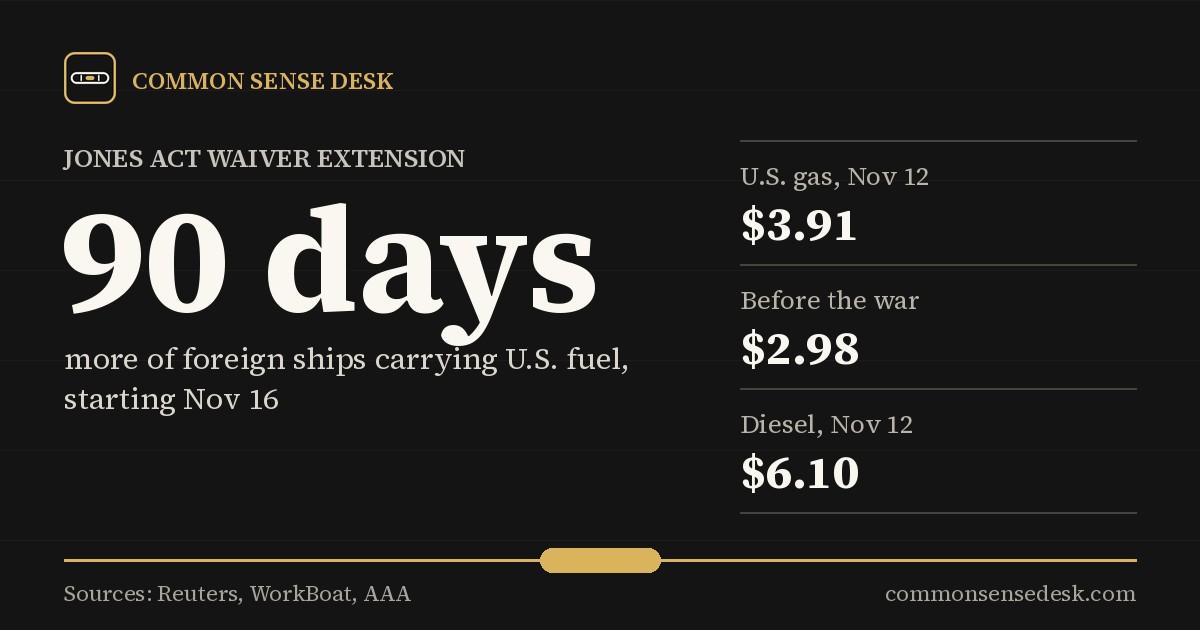
The White House has extended a waiver of an old shipping law for another 90 days, to make it easier and cheaper to move oil, gasoline and fertilizer around the country. President Trump extended the waiver of the Jones Act, a White House official said on Friday, November 13, according to Reuters.
It's not a headline that grabs most people. But it's one of the quieter reasons fuel prices aren't higher than they are. Here's what it means.
What the Jones Act is
The Jones Act is a law from 1920. It says that cargo moving between two U.S. ports, say from a refinery in Texas to a terminal in New England or to Puerto Rico, has to travel on ships that are built in the United States, owned by Americans and crewed by Americans.
Supporters say it protects American shipbuilding, American sailors and national security: in a war, the country needs ships and crews it can count on. Critics say it raises shipping costs, because there aren't many U.S.-built tankers and they cost more to build and run than foreign ones. That can mean it's sometimes cheaper to bring fuel from overseas than from another U.S. state.
What the waiver does
A waiver lets foreign-flagged ships carry oil and other goods between U.S. ports. The goal, Reuters reports, is to bring down gasoline, diesel and fertilizer prices that rose because of the war with Iran, by adding shipping capacity and easing bottlenecks.
- March: about a month after the U.S. launched the war with Iran, the administration issued a blanket waiver.
- August: the waiver was extended, but with a catch: each voyage now has to be approved case by case. The Maritime Administration checks first whether an American ship is available, according to WorkBoat.
- November: the new 90-day extension takes effect at midnight Eastern on November 16, so the waiver doesn't lapse, and it keeps the case-by-case reviews. Reuters calls it the longest waiver in the law's history.
How much has it been used? A White House official said the current waiver has supported about 13 million barrels of products, with gasoline making up more than a third and crude oil about 28 percent, according to WorkBoat. About 300 waivers were granted under the earlier blanket exemptions in March and May, compared with 48 under the case-by-case process since August, WorkBoat reported, citing Reuters.
Who's for it and who's against it
Oil and chemical companies like it. They say it lets them move crude oil and fertilizer more efficiently and at lower cost, according to WorkBoat.
Shipbuilders and members of Congress who support the Jones Act don't. They say it weakens protections the country needs for its shipbuilding industry. The American Maritime Partnership, which represents the U.S. domestic maritime industry, said: "AMP calls for a prompt end to the waiver." It urged the administration to keep "scrutinizing all waiver requests" to make sure they meet "the statutory standard of military necessity."
The common-sense view
Both sides have a fair point. A country at war needs a strong merchant fleet and shipyards, and that's hard to rebuild once it's gone. But families are also paying a lot more for fuel than they did a year ago, and blocking cheaper shipping during a fuel crunch is a hard sell. The case-by-case approach is a reasonable middle ground: use American ships when they're available, and foreign ones when they're not. The bigger question, which Congress keeps putting off, is how to build more American ships so that waivers aren't needed in the first place.
What it means for your wallet
The waiver doesn't cut prices by itself, but it helps keep supply moving, especially to places that depend on fuel shipped by sea, such as the East Coast and Puerto Rico. Without it, some shipments could get more expensive or slower right as winter heating demand picks up.
The numbers show why it matters. The U.S. average for regular gas was $3.91 a gallon on November 12, compared with $2.98 before the war, according to AAA figures cited by WorkBoat. Diesel was $6.10, up from $3.76. Diesel moves trucks, trains and farm equipment, so it shows up in nearly everything you buy. And fertilizer costs feed straight into food prices.
Gas has been falling lately, but this week's Iran news has pushed oil back up. You can track gas, diesel and other prices every week on our Wallet Watch page, and read more about this week's oil swings here: Trump says "we don't need a deal with Iran".
What to watch next
- Whether Congress pushes back on the extension, especially lawmakers from shipbuilding states.
- How many voyages get approved under the case-by-case rules this winter.
- The waiver's end date in mid-February, and whether the Iran war is over by then.
Sources
- Reuters via Investing.com: US extends shipping law waiver 90 days, to allow freer movement of oil, commodities investing.com
- WorkBoat: Jones Act waiver extended again workboat.com
- OilPrice.com: Trump extends Jones Act waiver for another 90 days oilprice.com
- AAA Gas Prices gasprices.aaa.com