

We may earn a commission from Amazon links on this page, at no extra cost to you. As an Amazon Associate, Common Sense Desk earns from qualifying purchases.
A Quebec Superior Court judge has suspended the province's 2022 law that made the oath of allegiance to the King optional for members of the National Assembly. Until the courts say otherwise, Quebec's elected members have to swear that oath before they can take their seats.
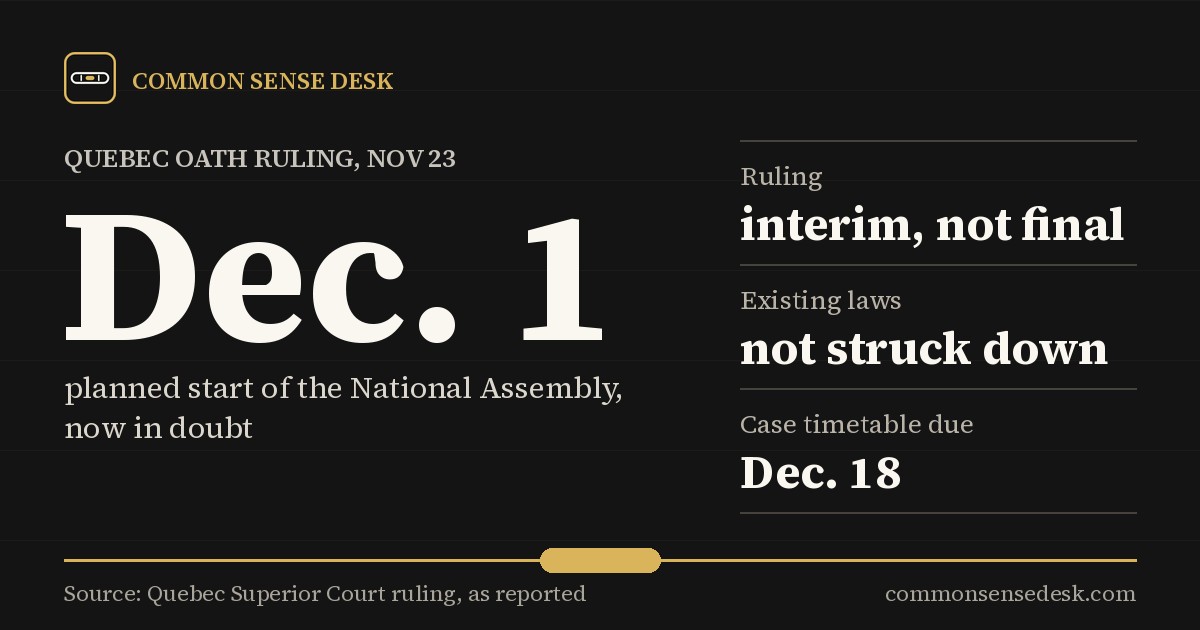
The ruling by Justice Ian Demers came on Monday, November 23. Premier Paul St-Pierre Plamondon says he won't swear allegiance to the King, and his government plans to appeal. The legislature is due to start sitting on December 1.
Online, the ruling is being called a "constitutional crisis," and some posts claim Quebec's laws are now invalid. The decision is a big deal, but it doesn't say that. This is what it actually does, and what it doesn't.
What the judge decided
Justice Demers suspended the 2022 law while a constitutional challenge against it goes ahead, according to court coverage of the decision. It's an interim order, not a final ruling on whether the law is valid. The full case hasn't been heard on its merits yet, and Demers told the parties to file a timetable for it by December 18.
His order takes effect even while it's appealed. That means the old rule is back for now: members must take the oath to the King, in addition to the oath to the people of Quebec, before sitting.
Demers found that the province likely overstepped its powers when it passed the law. "The Constitution is not an à la carte menu from which an individual subject to its authority may choose to follow only what suits them," he wrote.
The challenge was brought by Ottawa lawyer Lawrence David and the Public Interest Litigation Institute he founded. David filed his lawsuit in August.
Why the oath is in the Constitution
Section 128 of the Constitution Act, 1867, says members of provincial legislatures must take an oath of allegiance to the monarch before taking their seats. It applies to every province, not just Quebec.
In 2022, newly elected Parti Québécois members, including St-Pierre Plamondon, refused to take that oath and were kept out of the Assembly. In December 2022, the legislature passed a law, with support from all parties, saying the oath to the people of Quebec was the only one required to sit. The PQ members then took their seats without swearing to the King.
The question in court is whether a province can change that requirement on its own. Changes to the office of the King in Canada generally need agreement from Parliament and every provincial legislature. For background on how Canada's monarchy actually works day to day, D. Michael Jackson's The Crown and Canadian Federalism is a clear, nonpartisan guide.
Read next: Navdeep Bains wins Ontario Liberal leadership on third ballot, edging Lee Fairclough
Claim check: "Quebec's laws are invalid"
Not what the ruling says. The judge did not strike down any existing Quebec laws. Laws passed since 2022 remain on the books.
What Demers did was warn about the future. He said caution was warranted, because laws passed by members who haven't taken the required oath could later be challenged as invalid. Université de Montréal law professor Karine Millaire put it this way: if members don't take the oath, it would put the validity of all upcoming legislation in jeopardy. That's a risk for bills passed from now on, not a ruling on past ones.
Claim check: "constitutional crisis"
A real standoff, but not a collapse. There's a genuine conflict here: a court says members must swear an oath, and the premier says he won't. If it isn't resolved, the Assembly may not be able to sit, or may sit under legal doubt.
But the ruling doesn't remove the premier from office, bring down the government or stop the province from functioning, according to coverage of the decision. Courts, ministries and public services keep working. Disputes like this have a normal route: an appeal, and possibly the Supreme Court of Canada.
What the parties are saying
St-Pierre Plamondon said he will consider "all legal and political options to respect democracy." He added: "I cannot take an oath to the King of England." His government plans to ask the Quebec Court of Appeal to suspend the part of the judgment that makes it take effect immediately.
Liberal leader Charles Milliard said he's open to any solution that lets the December 1 start go ahead. "Let's be pragmatic and get to work," he said.
Conservative leader Éric Duhaime said he hopes the Court of Appeal overturns the ruling, but that "these battles against the monarchy must in no way prevent or delay the resumption of parliamentary work next Tuesday."
For the longer story of Quebec's place in Canada's constitution, Peter H. Russell's Constitutional Odyssey covers the fights from 1867 through the referendums.
What it means for Quebecers
Day to day, very little for now. Government services, health care, schools and existing laws are unaffected.
The practical risk is delay. The Assembly has already pushed its start date back twice, from November 17 to November 24 and then to December 1. If members can't sit, new bills, including any spending measures, wait. And if members sit without taking the oath, anything they pass could face court challenges later, which is the kind of uncertainty businesses and public bodies don't like.
There's also a bigger political backdrop. The PQ campaigned on moving Quebec away from the monarchy and toward independence. A fight over the oath gives that debate a very public stage. D. Michael Jackson's Royal Progress looks at why the monarchy remains in Canada's system and what it would take to change it.
What to watch
- Whether the Court of Appeal suspends the order before December 1.
- Whether the Assembly opens on December 1, and whether members take the oath.
- The December 18 deadline for a timetable in the full constitutional case.
- Any move to take the question to the Supreme Court of Canada.
We'll add a dated update when the Court of Appeal rules.
More from Common Sense Desk
Sources
- Quebec Superior Court, Justice Ian Demers, decision of Nov. 23, 2026
- National News Service (via NetNewsLedger): Quebec court suspends law removing oath to King for legislature members netnewsledger.com
- The Globe and Mail: Quebec court rules provincial legislators must swear oath to King theglobeandmail.com
- CBC News (via Yahoo News Canada): Quebec's legislative session in limbo as court mandates oath to the King (party reactions; no Canadian Press copy available) ca.news.yahoo.com
- CTV News: Quebec judge suspends law that removed mandatory oath to the King ctvnews.ca
- Constitution Act, 1867, section 128