

We may earn a commission from Amazon links on this page, at no extra cost to you. As an Amazon Associate, Common Sense Desk earns from qualifying purchases.
A federal appeals court on Monday, November 23, gave President Trump a new chance to move his New York hush money case into federal court, where he could then ask a judge to throw out his conviction on presidential immunity grounds, the Associated Press reported.
The ruling doesn't erase the conviction. It stays on the record for now. But it reopens a path Trump's lawyers have been pushing for more than three years, and it may freeze his separate appeal in New York's state courts while the federal fight plays out.
What the court decided
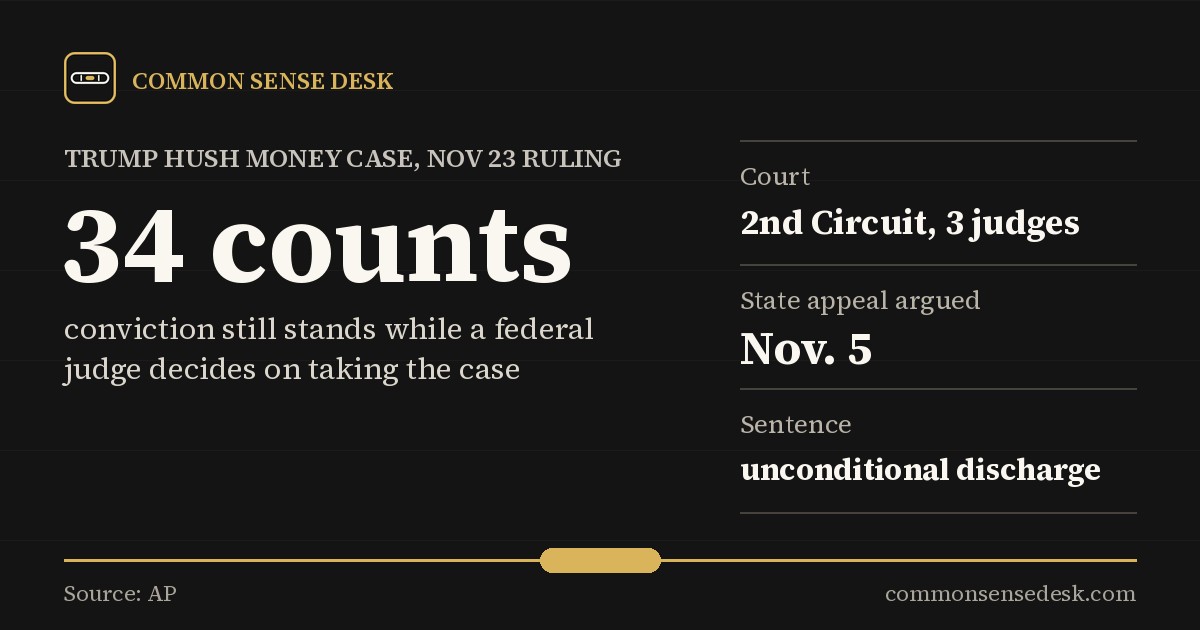
A three-judge panel of the 2nd U.S. Circuit Court of Appeals in New York reversed a lower court decision that had kept the case in state court. In a two-page order, the panel said the late U.S. District Judge Alvin Hellerstein "erred in holding that removal is categorically unavailable in a state criminal case" after a conviction, according to the AP.
The panel also said Hellerstein was wrong to find that Trump lacked "good cause" for his two attempts to move the case, one after he was indicted and one after his trial. It ordered a federal judge to promptly decide whether the federal court in Manhattan should take over the case. Hellerstein died last month at 92, so a different judge will make that call.
The judges on the panel were Raymond J. Lohier Jr., John M. Walker Jr. and José A. Cabranes. Lohier and Cabranes were appointed by Democratic presidents and Walker by a Republican, the AP noted.
How we got here
Trump was indicted in Manhattan in March 2023. A jury convicted him in May 2024 on 34 felony counts of falsifying business records to hide a $130,000 payment to adult film performer Stormy Daniels before the 2016 election. He denies wrongdoing. In January 2025, Judge Juan Merchan sentenced him to an unconditional discharge, meaning no jail, fine or probation, but the conviction stayed on his record. He's the first U.S. president convicted of a crime.
Weeks after the indictment, Trump first asked to move the case to federal court. He tried again after the trial, this time pointing to the Supreme Court's July 2024 ruling that presidents can't be prosecuted for official acts, and that prosecutors can't use official acts as evidence to prove that unofficial ones were illegal.
Hellerstein turned him down. "Paying hush money to an adult film star or engaging in a cover-up of an embarrassment are not subsumed in presidential immunity," he wrote. An earlier 2nd Circuit panel sent the question back to him for a closer look at the evidence, and he ruled against Trump again in August. Trump then asked the appeals court to step in.
Read next: Supreme Court won't hear Trump appeal over cut UC research grants
Why federal court matters to Trump
Federal law lets federal officers, including presidents, ask to be tried in federal court for charges tied to things they did in office. Trump's lawyers say the hush money case belongs there because prosecutors used evidence the Supreme Court's immunity ruling later put off-limits.
His lawyer, Robert Giuffra Jr., told the panel that evidence included testimony about Trump's "Oval Office conversations, workflow and social media posts," the AP reported. He also argued that the prosecution's theory, that the payment was an illegal campaign contribution, is a question of federal election law that belongs in federal court.
The practical stakes are speed and the final say. Giuffra warned that without federal involvement, Trump "will likely have to wait years" for New York's appeals courts to rule before he could reach the U.S. Supreme Court. If a federal judge takes the case, Trump could ask that judge directly to toss the verdict on immunity grounds.
For readers who want the background on how far presidential power reaches, Arthur Schlesinger Jr.'s classic The Imperial Presidency is still the standard history of that argument.
What the two sides said
A spokesperson for Trump's legal team said the president "appreciates the 2nd Circuit's prompt and correct ruling, as he continues to win against Democrat weaponization of our Justice System."
The Manhattan District Attorney's office declined to comment, according to the AP. At last week's hearing, Steven Wu, who heads the office's appeals division, had urged the judges to keep the case in state court.
What happens to the state appeal
Trump has also been appealing his conviction the normal way, through New York's courts. His appeal was argued before the state's mid-level Appellate Division on November 5. That court hasn't ruled, and under Monday's order it could be prevented from ruling for as long as the federal question is open, the AP reported.
That means the case now sits in a kind of holding pattern: a conviction on the books, no sentence to serve, and two court systems waiting on each other.
What it means
For most people, nothing changes day to day. Trump faces no punishment either way, since his sentence carried none. What's at stake is the record and the legal precedent.
If a federal judge keeps the case and throws out the verdict on immunity grounds, it would be the biggest test yet of how the Supreme Court's 2024 immunity ruling applies to conduct before and around a president's time in office. If the judge sends it back to state court, the New York appeal picks up where it left off.
It's also a reminder of how much of the federal system runs on rules most people never think about, like which court gets a case. A pocket copy of the U.S. Constitution covers the basics, and the Federalist Papers lay out what the founders thought a president's power should look like.
What to watch
- Which federal judge in Manhattan takes over the case, and how quickly they rule on keeping it.
- Whether that judge agrees the case belongs in federal court.
- If so, a motion from Trump to dismiss the verdict on immunity grounds.
- Whether the Manhattan DA asks the full 2nd Circuit or the Supreme Court to review Monday's order.
We'll add a dated update when the district court rules.
More from Common Sense Desk
Sources
- AP (via KSL): Federal appeals court gives President Donald Trump a path to erasing hush money conviction ksl.com
- Al Jazeera: Appeals court renews Trump bid for federal jurisdiction in hush-money case aljazeera.com