

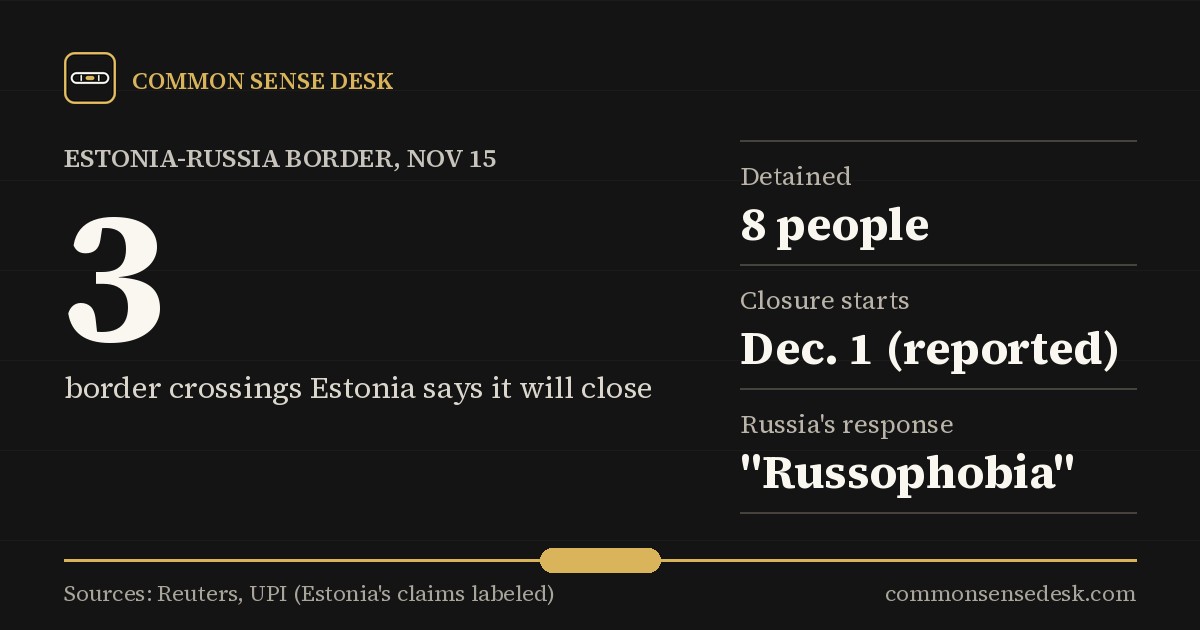
Estonia says it will close its border crossings with Russia, after what its security services call a Russian-ordered attempt to set fire to an Estonian drone maker. Eight people were detained. Nobody was hurt. Russia calls the move "Russophobia."
It's a big step for a small country that shares a long border with Russia, and it's the latest in a string of incidents along NATO's eastern edge. Here's what each side says and what it means.
What happened
Over the weekend, someone tried to set fire to Threod Systems, a defense company that makes long-range attack and reconnaissance drones, according to Reuters and UPI. The attempt failed, and nobody was injured.
Eight people were detained overnight in connection with it. Latvia's interior minister, Janis Dombrava, said several "Latvian citizens and non-citizens" were among those arrested, Reuters reported.
Estonia's Internal Security Service said the attack was ordered by the GRU, Russia's military intelligence agency. That's Estonia's account; Russia hasn't accepted it, and the investigation is ongoing.
The border closure
Foreign Minister Margus Tsahkna announced on Sunday, November 15, that Estonia will close its crossings with Russia. Estonia has three open crossings: Narva, Luhamaa and Koidula. UPI reported the closure takes effect December 1. Officials didn't say how long it will last.
"Russia must understand that hostile actions against Estonia come with consequences," Tsahkna wrote on X. "Closing the border crossings will reduce Russia's ability to conduct hostile activities in Estonia."
Prime Minister Kristen Michal said the closure "would reduce the threat to people in Estonia" and send a message that attacks on the country's defense industry are unacceptable, according to UPI. He also said Russian intelligence uses border crossings to exert influence over people.
Marko Mihkelson, who chairs the Estonian Parliament's foreign affairs committee, said the arrests showed Estonia was "prepared to respond swiftly to such attacks."
Some background on Estonia
Estonia is a country of about 1.3 million people on the Baltic Sea. It was part of the Soviet Union until it regained independence in 1991, and it joined both NATO and the European Union in 2004. About a quarter of its people are ethnic Russians, many of them in the northeast near Narva. Its land border with Russia runs a few hundred kilometres, much of it along the Narva River and Lake Peipus. Since Russia's full-scale invasion of Ukraine in 2022, Estonia has been one of the strongest voices in Europe for tough measures against Moscow, and it has already tightened entry rules for Russian citizens.
What Russia says
A spokeswoman for Russia's Foreign Ministry told the state news agency TASS that the plans were "yet another bout of aggressive and unrestrained Russophobia," according to Reuters. Moscow has denied involvement in similar incidents in the past.
The people in the middle
Border closures land hardest on ordinary people. Narva, Estonia's third-largest city, sits right on the border, across the river from the Russian town of Ivangorod, and most of its residents speak Russian. Many families have relatives on both sides, and some people cross for work, shopping, medical care or to visit elderly parents. For them, a closed border means long detours through other countries, or not seeing family at all.
That's worth keeping in mind. Governments make decisions about security; families live with the consequences.
A pattern along NATO's edge
Estonia, Latvia and Lithuania have reported a series of incidents in recent months, from drones to sabotage plots. Earlier this month, NATO jets were scrambled over drones near the Baltic states, which we covered in our NATO Baltic story. Finland closed its own border with Russia in 2023 over a surge of migrants it said Moscow was deliberately sending.
Defense companies like Threod matter here because the Baltic states have been building up their own military production. Estonia says targeting them is an attack on its security, not just on a business.
What it means for you
For North Americans, the direct effect is small. But Estonia is a NATO member, and NATO's treaty commits members, including the U.S. and Canada, to defend each other if one is attacked. Incidents like this one, below the level of open war, are exactly the kind of gray zone that tests how the alliance responds. Calm, firm responses matter, and so does making sure every accusation is backed by evidence.
What to watch next
- Charges against the eight people detained, and what evidence Estonia makes public.
- Whether the crossings close as planned on December 1, and for how long.
- Whether Latvia or Lithuania take similar steps.
Sources
- Reuters (via Al Jazeera): Estonia to close border crossings with Russia after attack on drone maker aljazeera.com
- UPI (via Yahoo News): Estonia to close border with Russia, prime minister says yahoo.com