

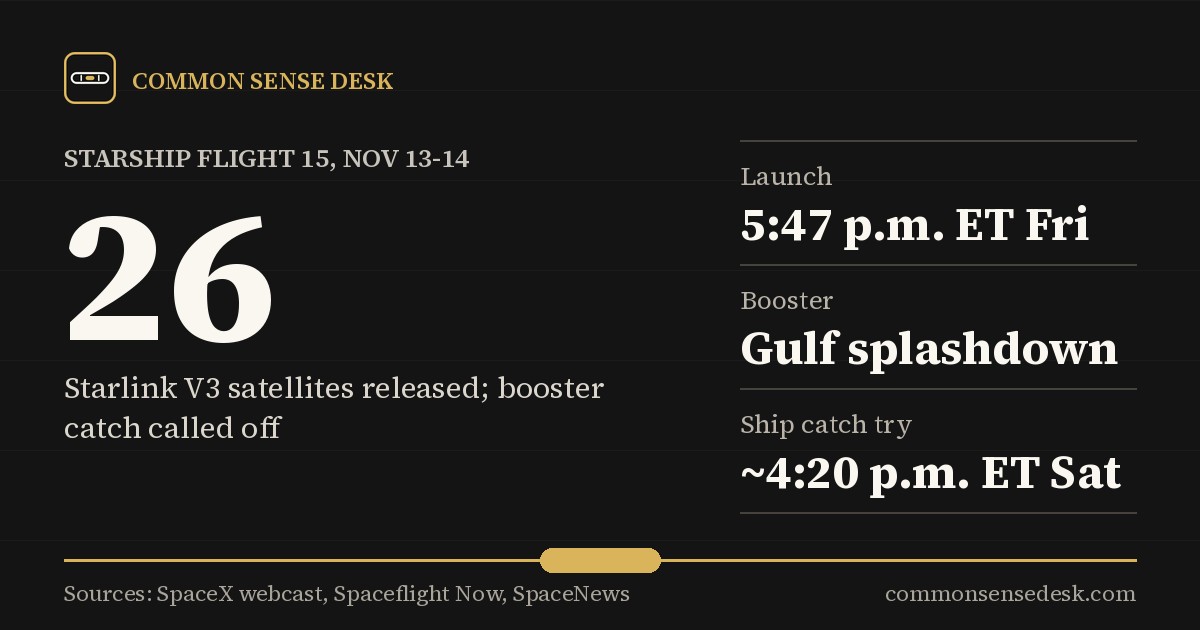
SpaceX launched its giant Starship rocket for the 15th time on Friday, November 13, and tried something nobody has done before: catch both halves of the rocket back at the launch tower. Half of that plan is already off. The Super Heavy booster called off its own catch and came down in the Gulf of Mexico instead. The ship, the upper stage, made it to orbit and is still up there. SpaceX plans to try to catch it this afternoon.
What happened Friday
Starship lifted off from Starbase, Texas, near Brownsville, at 5:47 p.m. Eastern, according to Spaceflight Now. This flight used Super Heavy Booster 22 and Ship 42.
A few minutes into the flight, the booster separated and turned back toward Texas. The plan was to fly it back to the launch tower and catch it with the tower's two big arms, the ones people call the "chopsticks." The booster was first cleared for the catch. Then, late in its trip back, it aborted the catch on its own.
SpaceX commentator Dan Huot said the booster "aborted itself" because of a guidance, navigation and control problem it detected. In plain words: the rocket's own computer didn't like something about how it was steering, so it chose not to come near the tower. That's exactly what it's built to do. A booster that isn't sure of itself should stay away from a launch pad that cost a fortune to build.
Instead, the booster went to a backup landing in the Gulf, about six and a half minutes after launch. Spaceflight Now reported that it exploded just before it hit the water. It won't be flown again.
The ship is in orbit
The good news for SpaceX is the upper stage. Ship 42 reached orbit and released 26 of SpaceX's newer Version 3 Starlink internet satellites, the company said on its webcast. That alone is a big step, because Starship is supposed to become the main way SpaceX puts its bigger satellites into space.
The ship was set up for a long coast of up to 14 orbits, about 22 hours in space. That's much longer than earlier test flights. It tests whether the ship can sit in space for most of a day and still come home in one piece, with its heat shield working.
The catch attempt today
SpaceX is aiming to bring the ship back to Starbase about 22.5 hours after launch. That works out to about 4:20 p.m. Eastern (3:20 p.m. Central) on Saturday, November 14, according to Spaceflight Now. On the way down it will fly over Mexico and South Texas.
No Starship upper stage has ever been caught by the tower. SpaceX has caught three Super Heavy boosters that way on earlier flights, starting in October 2024, but the ship is a different animal. It comes back from orbit at very high speed, it has to survive the heat of coming back into the air, and then it has to slow down and line up with the tower almost perfectly.
SpaceX has a backup plan. If anything looks wrong before the ship heads for Texas, the company can end the flight early and drop the ship in the ocean off Hawaii or off Chile instead. That keeps it far away from people and from the pad.
Why catching rockets matters
Most rockets in history were thrown away after one flight. It's like flying a jet across the country and then scrapping it at the gate. SpaceX changed that with its Falcon 9 boosters, which land and fly again many times, and that's a big reason launch prices have dropped.
Starship is meant to go further: both stages reused, quickly, like an airliner. Catching them at the tower saves the weight of landing legs and puts the rocket right back where it can be checked and refueled. If it works, it could cut the cost of getting things into space by a lot.
It also matters for NASA. The agency picked Starship as the lander to put American astronauts back on the moon under its Artemis program. That plan depends on Starship flying often and being refueled in orbit, which only makes sense if the rockets come back and fly again.
Is this a failure?
Not really, and it's fair to say so plainly. This is a test program, and SpaceX tests by flying, finding problems and fixing them. Losing a booster in the Gulf costs money and time, but nobody was hurt and the system did what it's designed to do when something looked off. The flight still put a ship and 26 satellites in orbit.
Whether the Federal Aviation Administration, which licenses these launches, will look into the booster's loss wasn't clear as of Saturday morning. We didn't see a statement from the agency about it.
What it means for you
For most people, the direct effect is small, but it's real over time. Cheaper launches mean cheaper satellites, and that shows up in things like satellite internet for rural homes, airline and ship Wi-Fi, weather satellites and GPS. Starlink already serves a lot of rural customers who don't have another good option for internet, and more capable satellites should mean faster service.
There's also the business side. SpaceX is a private company, but it's a big U.S. employer, and South Texas has grown around Starbase. And if you hold a fund that owns space or satellite companies, how fast Starship gets reliable affects that whole industry, including SpaceX's competitors.
And if you're near Brownsville or South Padre Island this afternoon, it's worth watching the sky and listening for the sonic booms as the ship comes home.
What to watch next
- Whether Ship 42 makes the tower catch around 4:20 p.m. Eastern today, or ends in the ocean.
- What SpaceX finds about the booster's guidance problem.
- Whether the FAA asks for an investigation before the next flight.
We'll update this story after the ship comes home.
Sources
- SpaceX: Starship Flight 15 webcast spacex.com
- Spaceflight Now: Starship in orbit ahead of catch attempt, booster diverts to explosive splashdown spaceflightnow.com
- SpaceNews: Starship launches on 15th test, calls off booster catch spacenews.com