

We may earn a commission from Amazon links on this page, at no extra cost to you. As an Amazon Associate, Common Sense Desk earns from qualifying purchases.
Quebec's Bill 21 stays. A teacher in Montreal who wears a hijab, a turban or a kippah still can't get a classroom job in the province's public schools, and a police officer still can't wear one on duty. The Supreme Court of Canada settled that on Friday, November 27, after more than seven years of court fights.
But the ruling also did something new. A majority of the judges said courts can now tell the public when a law shielded by the notwithstanding clause breaks Charter rights, even though they can't strike it down. That part is likely to outlast Bill 21 itself.
The case is English Montreal School Board, et al. v. Attorney General of Quebec, et al. Seven judges heard it over four days in March, with nearly 150 lawyers taking part, and the decision runs to more than 500 pages split into four sets of reasons. The appeals and Quebec's cross-appeal were dismissed, with no costs ordered.
Who won what
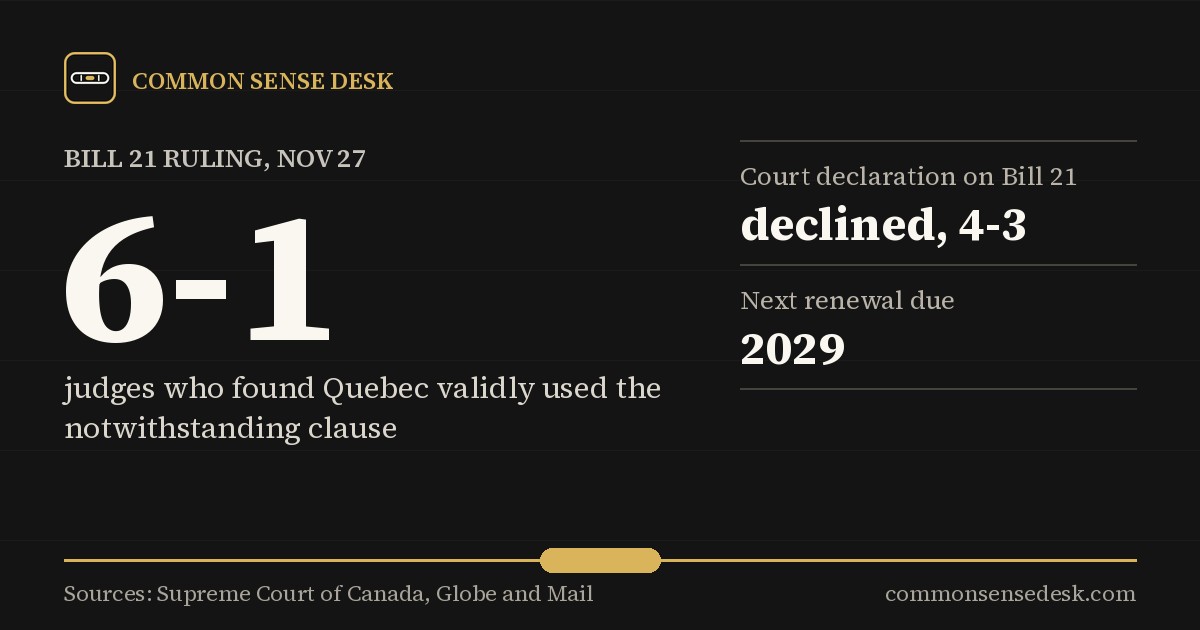
Chief Justice Richard Wagner wrote the lead reasons, joined by Justices Suzanne Côté and Malcolm Rowe. On the central question, six of the seven judges agreed Quebec used the notwithstanding clause properly when it passed the law in 2019. Wagner wrote that section 33 of the Charter only demands formal steps: an express statement naming the rights being overridden, and a five-year limit unless it's renewed. Courts can't go further and judge whether a government had good enough reasons to use it.
He described Bill 21 as "rooted in Quebec's legitimate and historical commitment to ensuring the laicity of the state." He also wrote that the law has "stigmatizing and deleterious effects on the persons so affected, most of whom are Muslim women."
The lone holdout on the clause was Justice Sheilah Martin. She would have struck down the core of the law under section 28, the Charter's guarantee that rights apply equally to men and women. Justices Andromache Karakatsanis and Michelle O'Bonsawin agreed with her on that point, but the court rejected the section 28 argument 4-3, with Justice Nicholas Kasirer siding with Wagner's group.
On declarations, the lineup flipped. Kasirer, Martin, Karakatsanis and O'Bonsawin, a majority of four, said superior courts may declare that a shielded law infringes the Charter. Wagner, Côté and Rowe said the Constitution "purposely does not confer" that power. Then the court voted 4-3 against issuing such a declaration in this case: Kasirer, Karakatsanis and O'Bonsawin wanted one, while Martin found it unnecessary.
Those three justices would have declared that sections 6 and 8 of the law, the religious-symbols ban and the face-uncovered rule, unjustifiably infringe freedom of religion, freedom of expression and equality rights. "Sections 6 and 8 of the Act put devout Quebecers in a terrible dilemma," Karakatsanis and O'Bonsawin wrote.
The one piece that fell
A small part of the law did not survive. The court found that section 8, which requires faces to be uncovered, can't apply to members of the National Assembly. That runs into section 3 of the Charter, the right to vote and to run for and sit in a legislature. The notwithstanding clause can't override section 3, and Quebec offered no justification, so the rule is of no force for MNAs. In practice it matters only to a member whose faith calls for a face covering. The religious-symbols ban for the justice minister and the Assembly's president and vice-presidents stands.
The English school boards also lost their argument under section 23, the minority-language education right. The court said accepting it would turn section 23 into a right to full institutional autonomy. For readers who want the background on how these Charter sections fit together, Peter W. Hogg's Constitutional Law of Canada is the standard reference that lawyers and judges reach for.
Who the law covers
Bill 21 bars people in positions of authority from wearing religious symbols at work: judges, police officers, prosecutors, government lawyers, and public school principals, vice-principals and teachers. People who were already in those jobs when the bill was tabled in March 2019 kept a right to continue, as long as they stay in the same position. Faces must be uncovered to give or receive certain public services.
The dissenting judges noted that every job file closed at the Centre de services scolaire de Montréal because of Bill 21 belonged to a Muslim woman wearing a hijab.
How Ottawa and the premiers reacted
Prime Minister Mark Carney, speaking to reporters in Yellowknife, said "We will not use the notwithstanding clause," and that the job of his government "is to defend the Charter of Rights and Freedoms," according to Global News. He said Ottawa fully respects the courts. Justice Minister Sean Fraser said the government is "carefully reviewing" the decision. Ottawa had asked the court to put limits on repeated use of the clause. That request was not accepted.
Quebec Premier Paul St-Pierre Plamondon objected to the declarations part of the ruling, saying "the Supreme Court introduces a new source of political and legal instability," Global News reported. Supporters of the law in Quebec see it as a democratic choice to keep the state neutral on religion, made by elected members, and see the clause as the tool that protects that choice. Bloc Québécois Leader Yves-François Blanchet called the ruling an "important victory" for Quebec, according to The Globe and Mail.
Alberta Premier Danielle Smith, whose government sided with Quebec in court, called the clause "a legitimate and essential part of our Constitution" and the ruling "a win for provincial rights." Manitoba Premier Wab Kinew took the opposite view, calling Bill 21 "legislative racism" while welcoming the part on declarations, which Manitoba had argued for. For a look at how the clause has been used and the reform debate around it, McGill-Queen's University Press published The Notwithstanding Clause and the Canadian Charter, edited by Peter L. Biro, with contributors on several sides of the question.
Rights groups and the people who sued
Opponents of the law see it as a ban that pushes religious minorities out of public jobs. Stephen Brown, CEO of the National Council of Canadian Muslims, said "The floodgates for a full attack on the Charter rights of Canadians has been opened," according to Global News. Howard Sapers of the Canadian Civil Liberties Association said "We are deeply disappointed that the Supreme Court has allowed Bill 21 to remain in force." The two groups challenged the law the day after it passed.
Amrit Kaur, a Sikh teacher who was one of the appellants, said "The fight for human rights continues." The English Montreal School Board said it was "deeply disappointed to have lost its appeal by the narrowest of margins." Frédéric Bérard, a lawyer for the FAE teachers' union federation, took a different view: "It's a good day for democracy," he said, pointing to the new power on declarations.
What comes next
The clause on Bill 21 expires every five years. Quebec renewed it in 2024, so the next renewal is due by 2029. A future government could let it lapse, renew it, or change the law. Any new challenge could now ask a court for a formal declaration that the law breaks the Charter, which would not change the law but would put the finding on record before the next renewal vote. Opponents are already asking Ottawa to pursue other routes, including a constitutional amendment, which would need provinces on board.
What it means for you
If you work, or hope to work, as a teacher, principal, police officer, prosecutor or judge in Quebec, nothing changes: the ban applies as before. Elsewhere in Canada, the ruling confirms that any province, or Ottawa, can use the clause with few legal limits, while giving people a new way to get a court to say a shielded law breaks their rights. A plain copy of the Canadian Charter of Rights and Freedoms is worth keeping handy as these debates move to other provinces.
More from Common Sense Desk
Sources
- Supreme Court of Canada: English Montreal School Board, et al. v. Attorney General of Quebec, et al., file 41231 (Nov. 27, 2026) scc-csc.ca
- The Globe and Mail: Supreme Court upholds Quebec's Bill 21 in landmark ruling on Charter of Rights (Nov. 27, 2026) theglobeandmail.com
- The Globe and Mail: Bill 21 Supreme Court ruling: Premiers welcome decision on Quebec secularism law as rights groups vow to continue fight (Nov. 27, 2026) theglobeandmail.com
- Global News: Carney commits to not using notwithstanding clause after Bill 21 ruling (Nov. 27, 2026) globalnews.ca
- Canadian HR Reporter: Supreme Court of Canada upholds Quebec's secularism law (Nov. 27, 2026) hrreporter.com