

The Supreme Court will decide whether President Trump can shut off asylum for most people who cross the southern border illegally. On Friday, November 13, the justices agreed to hear the administration's appeal of lower court rulings that found the policy illegal, according to the Associated Press. The policy stays in effect while the case goes on.
This is one of the biggest immigration cases in years. Here's what's at stake, what each side argues, and what happens next.
What the policy does
On his first day back in office, January 20, 2025, Trump signed a proclamation declaring an "invasion" at the southern border. Under it, people who cross without the required papers can be removed right away, without the chance to apply for asylum.
Asylum is the protection the U.S. offers people who can show they face persecution at home because of things like their religion, politics or ethnicity. For decades, federal law has said people who reach U.S. soil can ask for it, wherever and however they arrived. That's the heart of this fight.
How it got here
Immigrant rights groups, including the ACLU, sued. A federal district judge blocked the policy, and a federal appeals court in April upheld that ruling, finding the administration's effort violated the Immigration and Nationality Act, the main U.S. immigration law, according to Jurist and NBC News. The lower court rulings were put on hold, though, so the ban has stayed in force.
Now the Supreme Court will decide two main questions, according to Jurist: whether the president can bar these migrants from applying for asylum, and how broadly federal courts can block a policy like this in a class-action case. The justices declined to take up a third question the government raised about how the class of migrants was defined.
What the administration says
Solicitor General D. John Sauer, the government's top lawyer at the Supreme Court, called the restrictions "critical" and argued the administration can categorically deny asylum to people covered by the order, the AP reported.
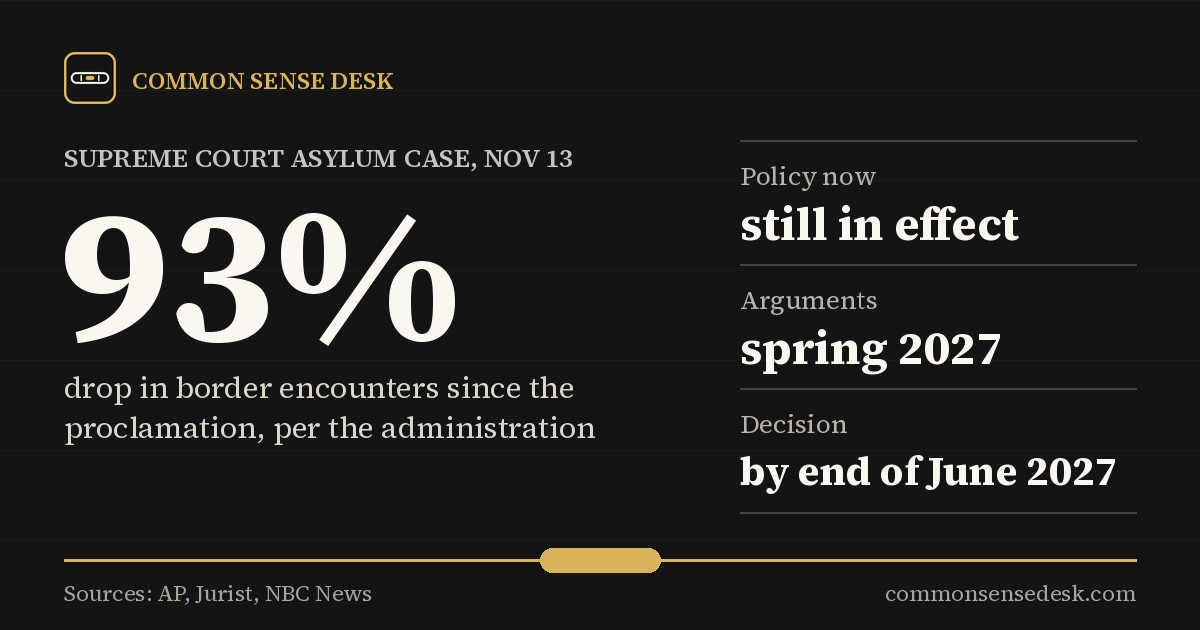
He pointed to results: "Since the proclamation took effect, border encounters have fallen by 93 percent," he wrote, to the lowest level since the 1960s. Federal lawyers also argue that asylum cases used to take years, and many migrants were released into the country while they waited, which encouraged more people to come.
What the challengers say
The ACLU and other immigrant rights groups argue that crossings were already falling before Trump took office, and that the order is an illegal attempt to "eviscerate" asylum protections that Congress wrote into law. They say a president can't override a law passed by Congress on his own.
"The plaintiffs in this case fled persecution and torture, including political imprisonment and threats from the Taliban," said Keren Zwick of the National Immigrant Justice Center, adding that the administration "refused to honor its obligation to consider them for asylum."
The real question underneath
Strip it down and the case is about who decides. The administration says the president has broad power to protect the border, especially in what it calls an emergency. The challengers say Congress already decided how asylum works, and a president can't simply switch it off.
Both sides have a point worth taking seriously. Most Americans want a secure border, and the numbers show the policy has cut crossings sharply. Most Americans also believe the rules should come from the law, not just from whoever is in office. The Supreme Court's job is to sort out which one the law actually allows.
This isn't the only border case at the court. Earlier this month, the justices let border wall construction resume in Texas's Big Bend region, which we covered in our Big Bend story.
What happens next
- Oral arguments are expected in the spring.
- A decision is expected by the end of June 2027.
- Until then, the asylum ban stays in effect.
What it means for you
For most families, the border shows up in a few practical places: local budgets for schools, hospitals and shelters in border states and big cities, the labor market in farming, construction and service jobs, and federal spending on enforcement. A ruling either way will shape those for years, and it will also set how much power any future president, of either party, has to act on immigration without Congress.
That last part is worth remembering. Whatever you think of this policy, the power the court approves or rejects here will belong to the next president too.
Sources
- AP (via PBS NewsHour): Supreme Court will consider Trump's executive order suspending asylum access at the southern border pbs.org
- Jurist: US Supreme Court to review President Trump's restrictions on asylum at southern border jurist.org
- NBC News: Supreme Court to rule on Trump's asylum ban nbcnews.com