

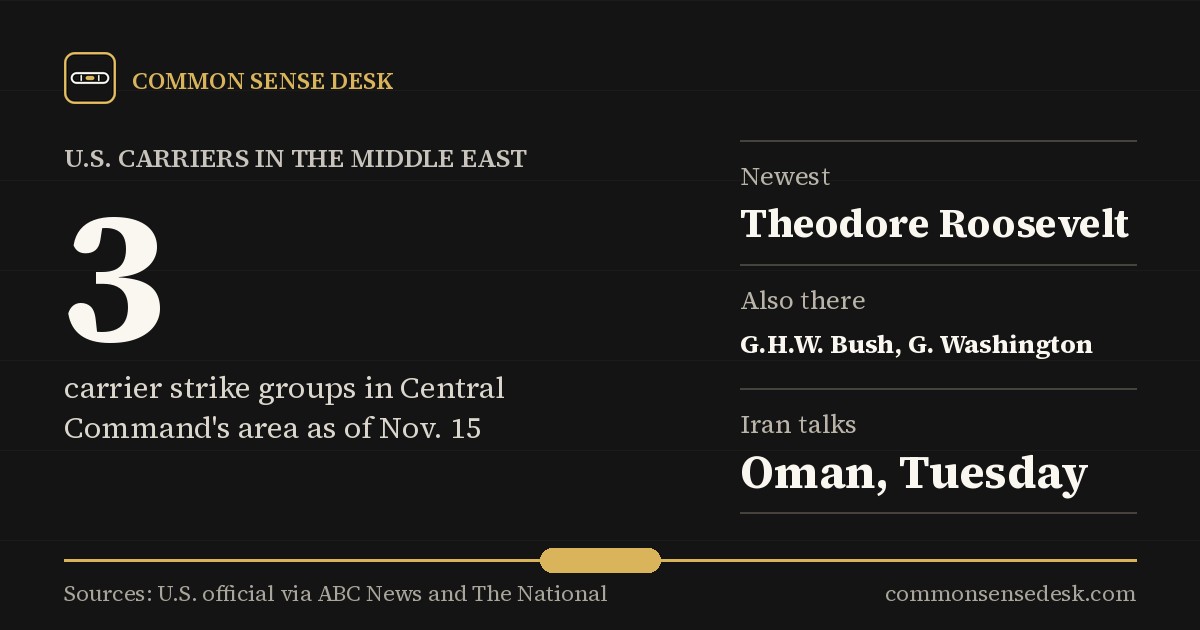
A third U.S. aircraft carrier has arrived in the Middle East. The USS Theodore Roosevelt and its strike group entered the area overseen by U.S. Central Command on Sunday, November 15, a U.S. official told ABC News and The National. It joins the USS George H.W. Bush and the USS George Washington, giving the U.S. three carrier strike groups in the region at once, an unusually large show of force during the conflict with Iran.
Here's what we know, what we don't, and why it matters.
What's confirmed
- The Roosevelt's strike group entered Central Command's area on Sunday, according to a U.S. official cited by ABC News and The National. There was no formal Pentagon announcement.
- The Roosevelt was originally sent to relieve the George Washington, which is staying in the region "for the moment," The National reported. That means the three-carrier overlap may be temporary.
- The Roosevelt carries Carrier Air Wing 11, with F/A-18 Super Hornet fighters, EA-18G Growler electronic-warfare jets, E-2D Hawkeye radar planes, Ospreys and Seahawk helicopters, according to USNI News, as cited by Army Recognition.
Being in Central Command's area doesn't mean all three carriers are together or close to Iran; that region stretches from Egypt to Central Asia. The Navy hasn't said where they're positioned.
The three ships
The Theodore Roosevelt is based in San Diego and sails with the Pacific Fleet. The George H.W. Bush is normally based in Norfolk, Virginia, on the East Coast. The George Washington is the Navy's forward-deployed carrier in Japan, based in Yokosuka. Pulling carriers from both oceans and from Japan at the same time shows how much weight Washington is putting on this region right now, and it also stretches the Navy thin elsewhere, including in the Pacific.
What's happening with Iran
The carrier arrived during a tense stretch. According to The National:
- On Sunday, Iran's Revolutionary Guard said it launched drones at a base in Bahrain that hosts U.S. Army assets, Iran's first strike on a Gulf state in weeks.
- On Friday, the Revolutionary Guard claimed it destroyed a U.S. early-warning radar in Bahrain; U.S. Central Command said it intercepted the two drones Iran launched. We covered that in our Bahrain story.
- Iranian state TV said five ships struck mines and caught fire within 48 hours, without naming them. The UK Maritime Trade Operations center reported an attack on a tanker in the Gulf, with the crew safe.
Those are each side's claims, and many can't be independently confirmed. Some reports also claimed Iran took control of a U.S. surveillance drone; we couldn't confirm that, so we're not reporting it as fact.
On the diplomatic side, Iran's foreign minister, Abbas Araghchi, is due in Oman on Tuesday to meet his Omani counterpart. Oman has often carried messages between Washington and Tehran. Efforts to end the conflict, which began with U.S. and Israeli strikes in February, haven't produced a breakthrough.
Why three carriers matter
An aircraft carrier is a floating air base with more than 60 aircraft and thousands of sailors. Having three in one region is rare; it usually means Washington wants maximum options, whether that's defending bases and shipping, deterring attacks, or being ready if talks fail.
It's also a message. Sending more carriers tells Tehran the U.S. can respond quickly and at scale. Supporters say that kind of strength is what keeps a bigger war from starting. Critics worry that so much firepower in one place raises the risk of a mistake turning into a wider fight. Both concerns are reasonable, and the next few weeks of diplomacy will matter.
And it's a reminder of the people involved: thousands of American sailors and aviators away from home over the holidays, and civilians across the region living with the threat of strikes.
What it means for your wallet
The Gulf and the Strait of Hormuz carry a large share of the world's oil. When tension rises there, oil prices usually rise too, and that shows up at the pump within weeks. Gas has been falling this month as fears eased; it's down to $3.81 a gallon, as we reported in our gas price story. A real flare-up, especially attacks on tankers or mines in shipping lanes, could reverse that quickly.
The common-sense move hasn't changed: don't panic-buy gas on a headline, but if you're planning a big Thanksgiving drive, filling up a few days early doesn't hurt.
What to watch next
- Whether the George Washington heads home, or all three carriers stay.
- Any new attacks on bases or ships in the Gulf.
- Araghchi's meeting in Oman on Tuesday, and any sign of renewed talks.
Sources
- The National: USS Theodore Roosevelt aircraft carrier arrives in Middle East thenationalnews.com
- Army Recognition (citing ABC News, USNI News): U.S. masses three aircraft carrier strike groups near Iran armyrecognition.com