

We may earn a commission from Amazon links on this page, at no extra cost to you. As an Amazon Associate, Common Sense Desk earns from qualifying purchases.
Virgin Plus, the discount mobile and internet brand owned by Bell, says an unknown party got into one of its internal systems on November 17 and may have seen customers' personal information. The company has started notifying customers by email and posted a notice on its website.
The good news, according to Virgin Plus, is that credit card numbers and bank account information were not affected. The less good news is that the details that were exposed are exactly the kind scammers use to make a fake message look real.
What Virgin Plus says happened
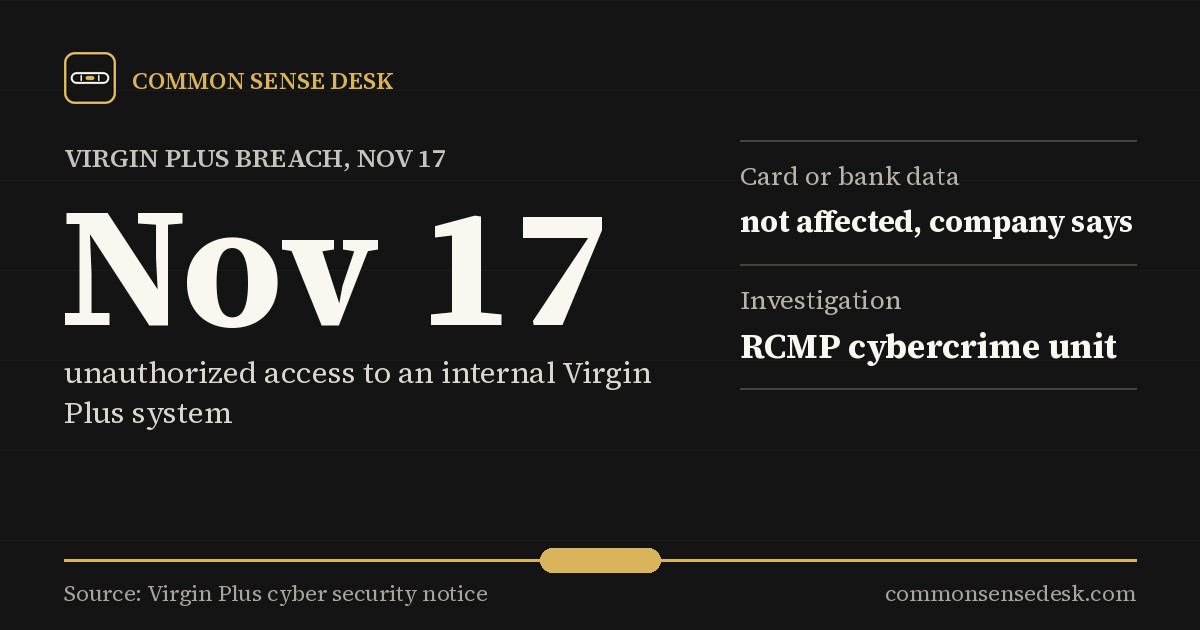
In its notice, titled "Important Cyber Security Update," the company says: "On November 17, 2026, an unknown party gained unauthorized access to an internal Virgin Plus system that included certain customer personal information."
Virgin Plus says it "immediately removed the threat actor and initiated emergency protocols" once it found the problem, and that it continues to monitor its systems. It has brought in the RCMP's cybercrime unit to investigate and says it will notify other regulators as required.
Asked in its own FAQ why customers are only hearing about this now, nearly a week later, the company says it "started informing customers as soon as we confirmed that some customer data may have been impacted."
Virgin Plus hasn't said how many customers are affected, who was behind the attack, or how they got in.
What may have been exposed
According to the notice, the information may include:
- your name
- your mailing address
- your phone number or numbers
- your email address
- your account number
- product information, such as what plan or service you have
- the date and amount of your last payment
What the company says was not exposed: credit card numbers and bank account information. It doesn't mention passwords or PINs being affected.
Same day as the Bell business breach
The date stands out. November 17 is also the day an attacker got into a testing version of a system Bell uses to set up network lines for business customers, which we covered in our story on the Bell cyberattack. In that case, business contact details were taken.
Bell and Virgin Plus haven't said whether the two incidents are connected, and we don't know. It could be one attacker, two separate attacks, or a coincidence. What is clear is that two parts of the same company reported unauthorized access on the same day.
Why this data matters even without your card number
A name, phone number, account number and the exact amount of your last bill don't let anyone empty your bank account. But they make it much easier to fool you, or to fool a customer service agent.
Picture a text that says: "Virgin Plus: your payment of $63.40 on November 3 failed. Update your card here." If that amount and date match your real bill, it's a lot more convincing than the usual junk. That's the main risk here.
The other risk is a SIM swap. With enough personal details, a scammer can call a carrier pretending to be you and ask to move your phone number to a new SIM card. If that works, they start receiving your texts, including the one-time codes banks send to confirm logins.
What to do
- Don't click links in messages that claim to be from Virgin Plus. Go to your account by typing the website address yourself or by opening the official app. Virgin Plus says it will never contact you to ask for bank account information, passwords or PINs.
- Add an account PIN or port-out protection. Call Virgin Plus or check your account settings and ask for extra verification before anyone can change your SIM or move your number to another carrier. This is the best protection against SIM swaps.
- Check your bills. Look for charges, plan changes or new lines you didn't ask for.
- Move off text-message codes where you can. For banking and email, an authenticator app or a hardware security key is much harder to steal than a text message.
- Use different passwords. If you've reused your Virgin Plus password anywhere else, change it. A password manager makes that easier, and a beginner's book like Cybersecurity For Dummies can help if you're starting from scratch.
- Report scams. If you get a suspicious call or text, you can report it to the Canadian Anti-Fraud Centre at antifraudcentre-centreantifraude.ca or 1-888-495-8501.
What it means for your wallet
For most customers, probably nothing directly, since no card or bank details were involved. The cost, if there is one, comes from falling for a follow-up scam. Ten minutes setting up an account PIN and turning on stronger sign-ins for your bank is cheap insurance.
It's also worth remembering that this is one more breach in a busy month. We've covered data exposures at Chase, Bell's business division and now Virgin Plus, along with a suspected breach of an FBI database. Good habits help with all of them at once.
What to watch
- How many Virgin Plus customers were affected.
- Whether Bell says the Virgin Plus and business-customer incidents are linked.
- Any findings from the RCMP investigation.
- Whether the federal privacy commissioner looks into it.
Sources
- Virgin Plus: Important Cyber Security Update (Nov. 2026) virginplus.ca