

We may earn a commission from Amazon links on this page, at no extra cost to you. As an Amazon Associate, Common Sense Desk earns from qualifying purchases.
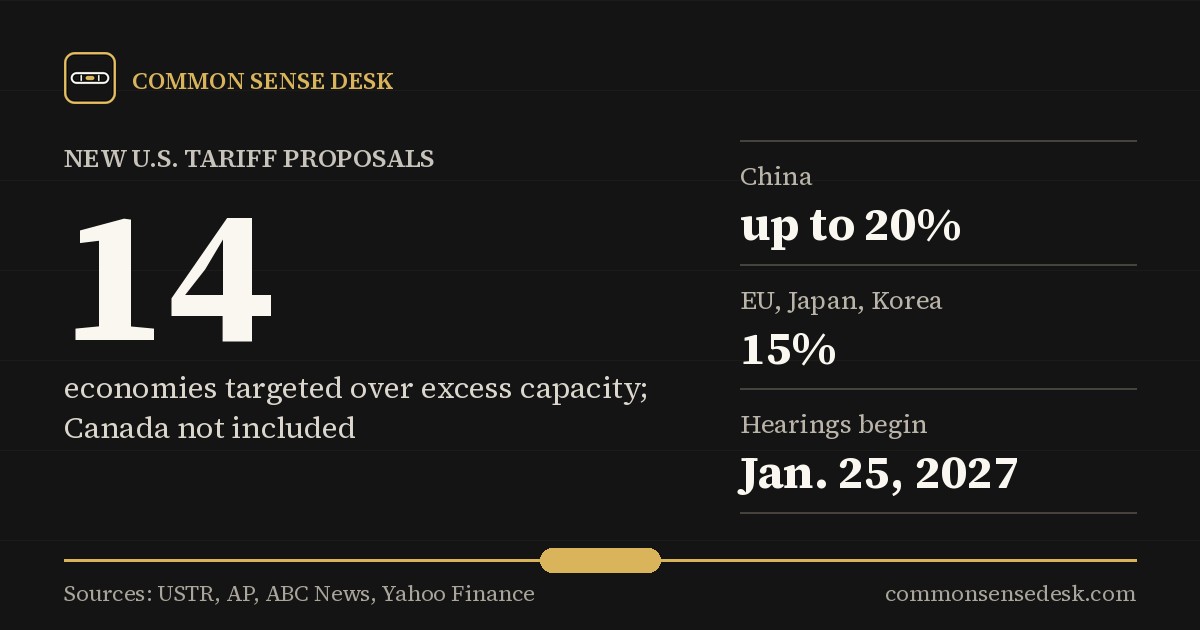
The Trump administration has proposed new tariffs on 14 economies, including China, the European Union, Japan and South Korea, after an eight-month investigation into what it calls structural excess capacity in manufacturing. The U.S. Trade Representative announced the proposals on Wednesday, November 25. They are not in effect yet: public comments and hearings come first, and officials say January is the earliest they could start.
Canada is not on the list.
Why the administration says it's acting
U.S. Trade Representative Jamieson Greer found that the 14 economies' "acts, policies, and practices" relating to excess manufacturing capacity "are unreasonable and burden or restrict U.S. commerce," according to the USTR's announcement. The finding was made under Section 301 of the Trade Act of 1974, the same law used for earlier tariffs on China.
The idea of "excess capacity" is central to the dispute: the argument that some countries produce far more than their own markets use, then sell the surplus abroad at low prices. Matthew Klein and Michael Pettis make the case for that view in Trade Wars Are Class Wars.
"President Trump is proposing to take action to bring about the elimination of these unfair acts, policies, and practices," Greer said in a statement, adding that the goal is to "level the playing field for American workers."
The new tariffs are also meant to replace many of the tariffs the U.S. Supreme Court struck down in February, according to AP and Yahoo Finance. On CNBC, Greer described them as "targeted tariffs that apply to a subset of goods from a given country," set at "a tariff rate that maintains the deals we made with them."
The proposed rates
According to the USTR announcement, the proposed maximum rates are:
- China: up to 20%, or 10% on some goods, on top of existing forced-labor tariffs. A U.S. official said the rate could double to 40% if China doesn't engage, AP reported.
- European Union, Japan, South Korea, Switzerland, Taiwan: 15%, matching the rates in their existing deals with the U.S.
- Vietnam: up to 35%, which could drop to 20% with a trade agreement.
- India: up to 25%, or 17% with an agreement.
- Singapore: up to 20%, or 10% with an agreement.
- Bangladesh, Cambodia, Indonesia, Malaysia, Thailand: up to 18% each.
Mexico and Norway were also investigated, but the USTR has made no determination on them yet. Semiconductors, cars, steel and aluminum are excluded because they're covered by separate tariffs, as are some energy and food products, Yahoo Finance reported.
Read next: Canada shifts from zero tariffs to the 'lowest rate' in U.S. trade talks
For the opposite view, that tariffs mostly raise costs at home, Douglas Irwin's Free Trade Under Fire is the standard economist's case.
When they could start
Written comments are due January 5, 2027, and hearings begin January 25, 2027, according to the USTR. "I don't think any of these would actually take effect earlier than a couple months from now," Greer told CNBC. The current U.S.-China trade truce runs until January 10, AP reported.
In many countries, the new tariffs would largely replace forced-labor tariffs of 10% to 12.5% that took effect in July, rather than add to them, according to Yahoo Finance and Capital Economics.
How other countries responded
China's foreign ministry spokesperson Guo Jiakun said Beijing opposes the excess-capacity finding being used "as a pretext," adding: "Tariff wars and trade wars serve no one's interests." China will take "necessary measures to defend its legitimate rights and interests," he said, according to AP.
The EU rejected "the premise that Europe is a source of structural overcapacity," AP reported. Japan's chief cabinet secretary said Japan has no "structural excess production capacity in the first place." Singapore said it was "very disappointed." Thailand said its 18% cap was "more favorable than expected."
A senior U.S. official said all the countries had been notified and that the administration does not expect retaliation, ABC News reported.
What it means for prices
Tariffs are paid by importers and often passed on to shoppers. Because the new duties mostly replace existing ones, the overall U.S. tariff level may not jump much. The Yale Budget Lab put the effective U.S. tariff rate at about 11.3% earlier this month, down from about 13.9% before the Supreme Court ruling, Yahoo Finance reported. Capital Economics said the new tariffs will likely help push prices higher and may keep goods inflation "firm into next year," AP reported.
The biggest exposure is on goods heavily made in the targeted countries: electronics and appliances from China and Southeast Asia, clothing and shoes from Vietnam and Bangladesh, and machinery and consumer goods from Europe and Japan.
For Canadians, the direct effect is limited, since Canada isn't targeted. But many products sold in Canada pass through U.S. supply chains, and Canada's own fight over U.S. tariffs on autos and steel continues ahead of the January 1 increase. We're following that in our Canada-U.S. trade coverage.
For a clear, nonpartisan explanation of how tariffs work and who pays them, Douglas Irwin's Clashing over Commerce is the standard history of U.S. trade policy.
What to watch
- The January 5 comment deadline and January 25 hearings.
- Whether China engages before the truce ends January 10, and whether its rate rises toward 40%.
- Deals that could lower rates for Vietnam, India and Singapore.
- Any USTR decision on Mexico.
More from Common Sense Desk
Sources
- Office of the U.S. Trade Representative: USTR makes determinations and proposes actions in 14 Section 301 investigations, Nov. 25, 2026 ustr.gov
- AP (via Yahoo News): China, other U.S. trading partners respond to proposed tariffs yahoo.com
- ABC News: Trump admin proposes new tariffs on China, EU and 12 other trading partners abcnews.com
- Yahoo Finance: US announces new tariffs on China, the EU, and 12 other nations finance.yahoo.com