

We may earn a commission from Amazon links on this page, at no extra cost to you. As an Amazon Associate, Common Sense Desk earns from qualifying purchases.
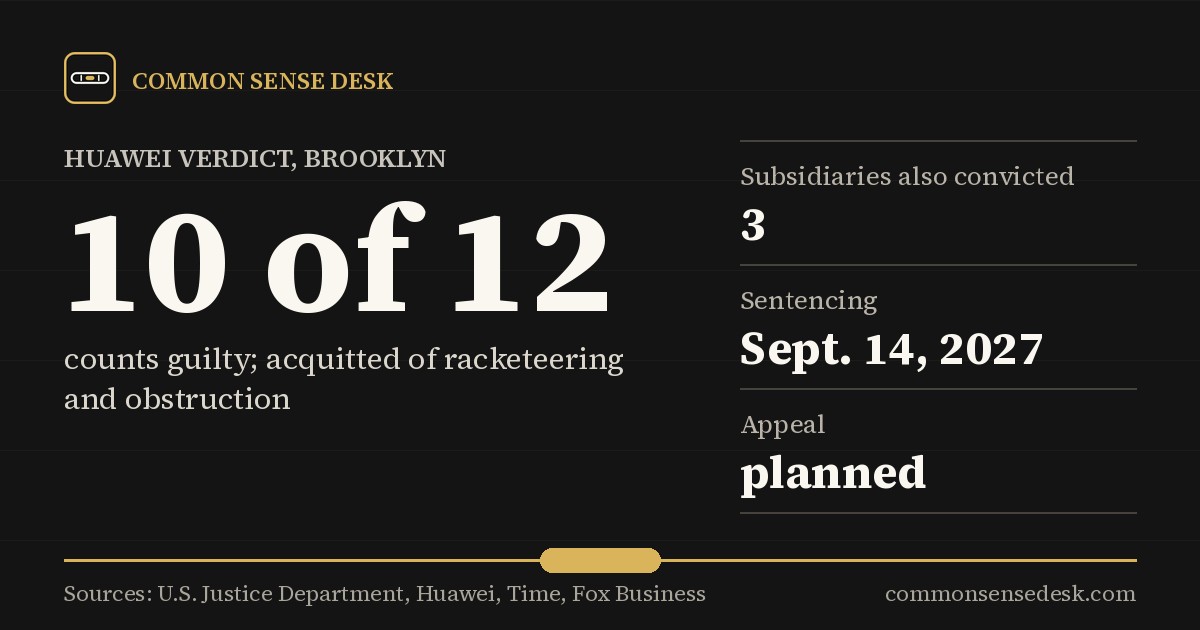
A federal jury in Brooklyn has convicted Chinese telecom giant Huawei and three of its subsidiaries on 10 of 12 criminal counts, including bank fraud, wire fraud, conspiracy to steal trade secrets from U.S. companies and violating U.S. sanctions on Iran. The verdict came on Tuesday, November 24, after a trial of about three months.
The jury acquitted Huawei on the two most sweeping charges: racketeering conspiracy, under the federal anti-organized-crime law known as RICO, and conspiracy to obstruct justice.
What the Justice Department said
"Few crimes are as serious as Huawei's decades-long pattern of endangering U.S. national security, violating the sanctity of U.S. commerce, and impeding the enforcement of U.S. laws," said Joseph Nocella Jr., the U.S. attorney for the Eastern District of New York, as quoted by Time.
"No person or company is above the law," Attorney General Todd Blanche said, according to Fox Business. Assistant Attorney General Tysen Duva said: "For over two decades, Huawei built its global empire on a foundation of fraud, theft, and deception."
What Huawei was convicted of
The counts include bank fraud, wire fraud, money laundering conspiracy, conspiracy to steal trade secrets and violations of the International Emergency Economic Powers Act, the law used to enforce sanctions, Fox Business reported. The three subsidiaries are Huawei Device Co., Futurewei Technologies and Huawei Device USA.
Iran. Prosecutors said Huawei did business in Iran through a subsidiary called Skycom, supplying telecom equipment and surveillance technology, while presenting Skycom to banks as an independent company. That let Huawei keep access to the U.S. dollar banking system despite sanctions, prosecutors said. Banks named in the case included HSBC, BNP Paribas and Standard Chartered, Time reported.
Trade secrets. Prosecutors said Huawei conspired over two decades to take technology from U.S. companies, including router source code from Cisco, antenna technology from Quintel, networking information from Fujitsu Network Communications, semiconductor equipment from CNEX Labs and phone-testing robot technology from T-Mobile. In the T-Mobile case, the jury saw video of a Huawei engineer detaching the arm of a testing robot and putting it in his backpack, Time reported. Huawei later fired the employee.
Read next: Records show the U.S. approved about 879,000 AI chips for China
What Huawei and Beijing said
Huawei said in a statement that it "welcomes" the acquittals on racketeering and obstruction and believes "the government's remaining charges are equally without legal or factual merit." It said it would "take all necessary legal actions to defend our rights and interests." The company said the trade-secret disputes cited at trial "were all civil matters that were resolved over the past two decades." Its lead lawyer, Brian Heberlig, told reporters Huawei will appeal, Time reported.
China's foreign ministry spokesperson Guo Jiakun said China "firmly opposes the U.S. suppression and containment of Chinese companies and firmly supports Chinese companies in safeguarding their legitimate rights and interests," according to Fox Business.
What happens next
Sentencing is set for September 14, 2027, the Justice Department said, with motions expected to begin in January. Because the defendants are companies, there's no prison time. Huawei faces fines, forfeiture and restitution, which could be large, though no dollar figure has been announced. U.S. District Judge Ann Donnelly oversaw the trial.
An appeal would go to the 2nd U.S. Circuit Court of Appeals and could take a year or more.
The Canada connection
Canadians will remember how this case began. In December 2018, Canadian authorities arrested Huawei's chief financial officer, Meng Wanzhou, in Vancouver on a U.S. warrant. She spent nearly three years under house arrest fighting extradition. Two Canadians, Michael Kovrig and Michael Spavor, were detained in China days after her arrest and held until she was released in 2021, after reaching a deferred prosecution agreement with U.S. prosecutors. Her charges were later dismissed. The HSBC banker she met in 2013 testified at the Brooklyn trial, Time reported.
Eva Dou's House of Huawei tells the full story of the company, from its founding to the Meng affair, in a balanced, readable way.
What it means
For consumers, little changes right away. Huawei has been largely shut out of the U.S. market for years. It was put on a Commerce Department blacklist in 2019, and its equipment has been barred from U.S. networks. Canada also banned Huawei and ZTE gear from its 5G networks in 2022.
The bigger effect is on U.S.-China relations, which have swung between deals and friction this fall. The verdict adds another point of tension at a time when chip exports and tariffs are already in dispute. For background on why chips sit at the centre of that fight, Chris Miller's Chip War is the best single book, and Michael Pillsbury's The Hundred-Year Marathon lays out one influential view of China's long-term strategy.
What to watch
- Post-trial motions starting in January, and Huawei's appeal.
- The size of fines and forfeiture at sentencing in September 2027.
- Any response from Beijing beyond words, such as action against U.S. companies in China.
More from Common Sense Desk
Sources
- U.S. Attorney's Office, Eastern District of New York: Huawei and subsidiaries convicted (as quoted by Time)
- Huawei statement on jury verdict, Nov. 25, 2026
- Time: China's Huawei convicted in U.S. over bank fraud, Iran ties time.com
- Fox Business (with Reuters): Federal jury convicts Huawei of stealing US trade secrets, violating Iran sanctions foxbusiness.com