

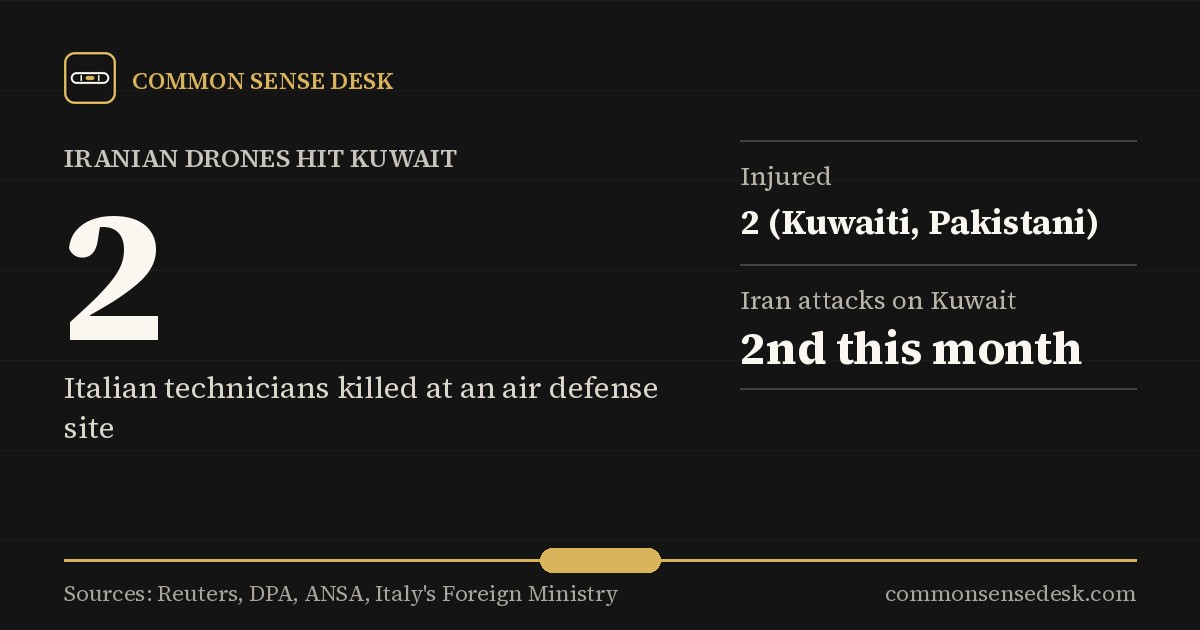
Two Italian civilians were killed in Kuwait on Thursday, November 26, when Iranian drones hit the air defense site where they were working. Italy's foreign minister, Antonio Tajani, gave the news to the Senate in Rome that afternoon. Both men were technicians for Rheinmetall Italia, the Italian arm of the German defense group Rheinmetall.
They weren't soldiers. According to Italy's Foreign Ministry and the Italian news agency ANSA, they were doing maintenance on the detection antennas of a Skyguard air defense system that Kuwait's armed forces use. The men were 36 and 65. La Voce di New York and Il Sole 24 Ore named them as Emanuele Lo Russo, 36, of Rome, and Antonio Saccoccio, 65, of Formia, a seaside town between Rome and Naples.
What happened at the site
"At around 2:00 PM today, several Iranian-made drones targeted Kuwaiti military installations, including an air defence detection station where two Italian technicians from Rheinmetall were working," Tajani told senators, as reported by ANSA.
"Following a powerful explosion, both of our compatriots, according to information coming from Kuwait, have died," he said, according to Reuters. "Two other people were injured: a Pakistani national and a captain in the Kuwaiti army."
Kuwait's account changed over the day. Its Defence Ministry first said four people had been wounded by falling debris when a "vital facility" was targeted, Reuters reported. It later confirmed that the two Italians had died of their injuries. The ministry said its forces detected and dealt with several drones in Kuwaiti airspace and that the attack also caused material damage. It did not say exactly what was hit or how many drones there were. A ministry spokesman called it "heinous Iranian aggression," La Voce di New York reported.
The Gulf Cooperation Council condemned the strike "in the strongest terms."
Iran's Foreign Ministry didn't respond to a Reuters request for comment on Thursday. As of Thursday evening, Iran hadn't said what it was aiming at.
Why it matters beyond Kuwait
The two men are among the first officially confirmed European deaths in the Iran war, which began with U.S. and Israeli strikes on Iran in late February, according to the German news agency DPA. A French soldier was killed in a drone attack in Iraq in March.
Italy isn't a party to the war. Prime Minister Giorgia Meloni was at a European Council summit in Brussels when she heard. Her office said she expressed her "deepest sorrow" and condolences to the families. Tajani said Italy's ambassador in Kuwait was informing the relatives.
It also puts a spotlight on the many civilian contractors who keep Gulf air defenses running. Skyguard is a fire-control radar that aims short-range air defense guns and missiles, and systems like it need regular maintenance, and much of that work is done by employees of the companies that make them. Those technicians work at the exact sites Iran says it's targeting. Rheinmetall declined to comment, Reuters reported.
Read next: Iran fires drones at U.S. base in Kuwait and attacks Bahrain after U.S. strikes on Qeshm
Kuwait keeps getting hit
Thursday's attack was the second reported Iranian attack on Kuwait this month, Reuters said. On November 18, Iran fired drones at Ali Al Salem Air Base, which hosts U.S. forces, a day after U.S. strikes on a Revolutionary Guard launch site on Qeshm Island in the Strait of Hormuz. Kuwait said then that its air defenses shot the drones down and reported no damage. We covered that attack and the Qeshm strikes at the time.
The difference this time is the dead. By the AP's count in mid-November, Ali Al Salem alone had been hit at least 30 times since February. U.S. bases, oil facilities and other sites in Kuwait have all come under fire, and there have been deaths and injuries before, including among U.S. troops, DPA reported. Kuwait has taken some of the heaviest fire of any Gulf state in this war.
Kuwait sits at the northern end of the Gulf, close to both Iraq and Iran, and hosts several U.S. bases. That makes it an easy target with short flight times for drones.
Where the war stands
Peace efforts are stuck. A truce memorandum signed in June didn't hold. The U.S. is enforcing a naval blockade of Iran's ports, and Iran still claims control of the Strait of Hormuz, where tankers have been hit in recent weeks. Talks through Oman and Qatar have produced no deal, and the U.S. now has three aircraft carriers in the region.
In Washington, the Senate voted 48-51 on November 19 against a measure that would have limited the president's war powers over Iran, the first such vote since the midterms.
What's still unknown
Several things weren't clear by Thursday night. Kuwait hasn't said how many drones came in, how many got through, or whether the Skyguard site itself was the target or was hit by debris from an interception. Italy hasn't said whether it will change any security advice for Italian workers in the Gulf. And Iran hasn't commented. We'll add a dated update line here if any of that comes out.
More from Common Sense Desk
Sources
- Reuters (via KWSN): Two Italians killed in Iranian drone attack in Kuwait, Italy says, Nov. 26, 2026 kwsn.com
- DPA (via Yahoo News): Iranian drone attack kills Italian Rheinmetall staff in Kuwait yahoo.com
- ANSA: Two Italians killed in drone attack on Kuwait ansa.it
- La Voce di New York: Iranian drone attack in Kuwait kills 2 Italian technicians lavocedinewyork.com