

We may earn a commission from Amazon links on this page, at no extra cost to you. As an Amazon Associate, Common Sense Desk earns from qualifying purchases.
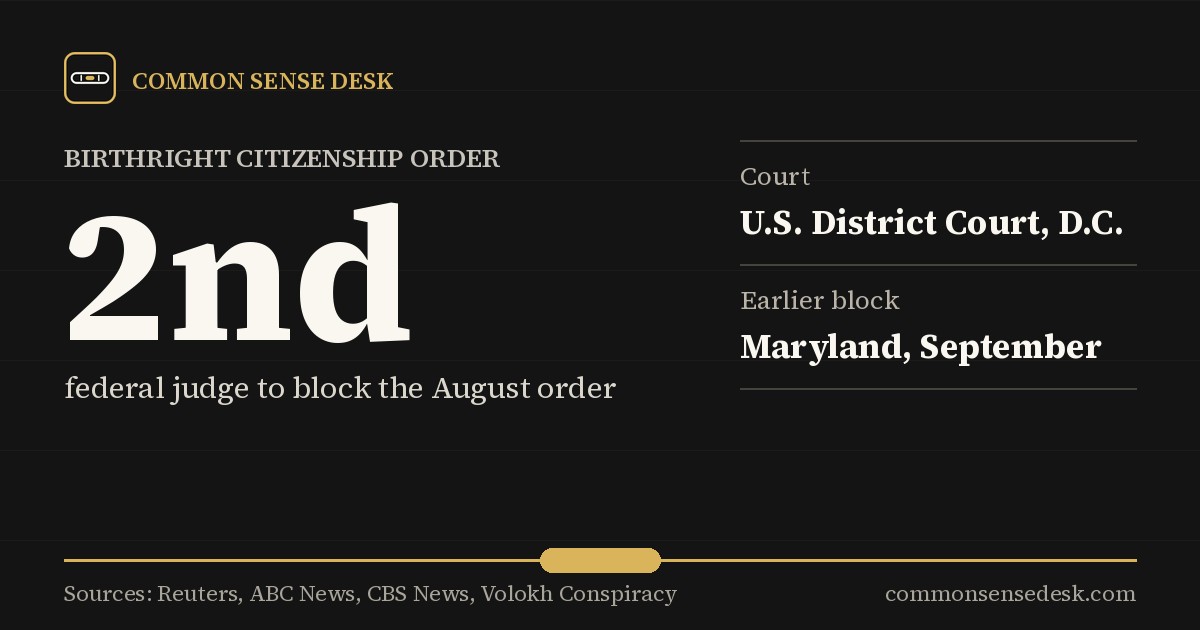
A second federal judge has blocked President Trump's August order narrowing who counts as a U.S. citizen at birth. U.S. District Judge Christopher Cooper in Washington, D.C., granted a preliminary injunction on Wednesday, November 25, and certified a class covering every child who would be denied citizenship under the order. For now, the State Department, the Department of Homeland Security and the Social Security Administration can't enforce it against any of those children, Reuters reported.
In practice, the order still can't be used against any child it was written to cover. A Maryland judge had already blocked it for a narrower group in September.
Which order this is
This isn't the order Trump signed on his first day back in office in January 2025. That one tried to deny citizenship to children whose parents were in the country illegally or only temporarily. The Supreme Court struck it down in June in Trump v. Barbara, ruling that it violated the Citizenship Clause of the 14th Amendment.
Trump responded with a narrower order in August, Executive Order 14418. "We had a very unfortunate decision in the Supreme Court concerning birthright. It was close, but a very, very unfortunate decision. So we're making adjustments because it's very unfair," he said at the time, according to ABC News.
The new order goes after smaller groups. It covers children whose noncitizen parent works for a foreign government or an international organization but doesn't have full diplomatic immunity, and children with a parent the government classifies as an "alien enemy," which the order ties to designated terrorist groups. It also targets what the administration calls "birth tourism," meaning travel to the U.S. to give birth so the child gets citizenship, and Judge Cooper's opinion lists children born through commercial surrogacy arrangements as well, according to the legal blog The Volokh Conspiracy. A separate part deals with American Samoa, where citizenship is set by Congress, not the Constitution.
The text everyone is arguing over is one sentence long. Anyone who wants to read it in context can keep a pocket copy of the U.S. Constitution handy: "All persons born or naturalized in the United States, and subject to the jurisdiction thereof, are citizens of the United States."
What the judge said
"The merits in this case are clear-cut," Cooper wrote, according to Reuters. "The Supreme Court has twice confirmed that all children born in this country are US citizens, save only for the small handful who are not subject to US law." The two Supreme Court rulings he meant are United States v. Wong Kim Ark in 1898 and Barbara this year.
He added that "the President cannot carve out new exceptions to birthright citizenship for children born within the United States and subject to its laws." In another passage quoted by ABC News, he wrote: "Earlier this year, the Supreme Court kept that promise by striking down EO1. This Court does so again today by enjoining EO2's application as to the certified class."
Cooper, an Obama appointee, also found that the children faced irreparable harm without an injunction, one of the tests for blocking a policy before a case is fully decided. The case is called Nathan v. Trump.
Read next: Supreme Court will decide if Trump can bar most asylum claims at the southern border
The two sides
The White House pushed back hard. "This is just another ruling from an activist judge appointed by Obama attempting to thwart President Trump's commonsense agenda," a spokesperson said in a statement to ABC News. "The birthright citizenship executive order is consistent with the holdings and analysis set forth by the Supreme Court."
That's the government's core argument: Barbara threw out the first order but didn't stop the president from drawing lines around the old, narrow exceptions, such as diplomats' children. In the Maryland case, the Justice Department argued the Supreme Court had only found that children of temporary or undocumented immigrants "are not disqualified," CBS News reported.
Lawyers for the children say the Supreme Court already settled who the exceptions are. "Enough is enough," Cody Wofsy, an ACLU lawyer who represented the plaintiffs, told Reuters. "The Supreme Court has twice rejected efforts to gut birthright citizenship, in 1898 and again earlier this year. Third time is not the charm."
Readers who want both sides of the original-meaning debate can compare Akhil Reed Amar's America's Constitution: A Biography with the clause-by-clause commentary in The Heritage Guide to the Constitution.
Two courts, same result
Cooper isn't the first. In September, U.S. District Judge Deborah Boardman in Maryland blocked the same August order for a class of children in a case brought by several immigrants and the advocacy group CASA. She called the order "almost certainly unconstitutional as applied to the certified class," CBS News reported.
The D.C. class is a bit wider. Cooper certified a class of all children who "are or will be unlawfully denied citizenship under the Order," while the Maryland class was "slightly narrower," according to law professor Ilya Somin, writing in The Volokh Conspiracy. To ever enforce the order, the administration would now have to overturn both rulings, Reuters noted.
Class actions are the route these cases take now because of the Supreme Court's 2025 ruling limiting nationwide injunctions. A single judge can no longer simply block a policy for the whole country; certifying a class is how courts reach everyone in the same situation.
What comes next
A preliminary injunction isn't a final ruling. The case goes on in Cooper's court, and the government can appeal to the D.C. Circuit. The Justice Department hadn't responded to ABC News, and neither the White House nor DOJ said whether an appeal is coming. If both appeals courts side with the children, the administration's last option would be the Supreme Court, which ruled on the first order only five months ago.
Would the justices take up a second birthright case this soon?
More from Common Sense Desk
Sources
- Reuters (via Yahoo News): Trump's newest order curtailing birthright citizenship is blocked by second judge, Nov. 25, 2026 yahoo.com
- ABC News: Judge blocks latest Trump effort to restrict birthright citizenship abcnews.com
- CBS News: Judge blocks Trump's latest effort to narrow birthright citizenship, Sept. 3, 2026 cbsnews.com
- The Volokh Conspiracy (Reason): Second district court rules against Trump's new birthright citizenship executive order reason.com