

We may earn a commission from Amazon links on this page, at no extra cost to you. As an Amazon Associate, Common Sense Desk earns from qualifying purchases.
The short answer: Something really did crash near Roswell, New Mexico, in 1947, and the Army really did announce it had recovered a "flying disc." But the U.S. Air Force's own investigations found the debris came from a secret balloon program called Project Mogul, and the later stories of alien bodies don't hold up. A 2024 Pentagon review found no evidence of alien technology.
In the summer of 1947, a rancher in the New Mexico desert found a field scattered with strange debris: sticks, foil, rubber and tough paper. A few days later, the Army announced to the world that it had recovered a "flying disc." Within a day, it took that back.
That 24-hour stretch launched the most famous UFO story in the world. First the story the way people tell it, then what the records show.
The story
In June or early July 1947, rancher W.W. "Mac" Brazel found the debris on the ranch he managed, about 75 miles from the town of Roswell. He took some of it to the local sheriff, who called Roswell Army Air Field, home of the only unit in the world then trained to drop atomic bombs.
On July 8, 1947, the base issued a press release saying it had recovered a "flying disc." The Roswell Daily Record ran the headline "RAAF Captures Flying Saucer on Ranch in Roswell Region." The news went around the world in hours.
The next day, Brig. Gen. Roger Ramey in Fort Worth, Texas, said the debris was just a weather balloon and its radar reflector. Photos showed an officer, Maj. Jesse Marcel, holding pieces of foil and sticks. The story died almost overnight.
It came back more than 30 years later. In 1978, Marcel, by then retired, told a UFO researcher that the debris had been unlike anything on Earth and that the weather balloon was a cover story. A 1980 book, The Roswell Incident, followed, and over the next decade more witnesses came forward with stories of a crashed craft, alien bodies and a military cover-up. For a careful academic look at how that happened, UFO Crash at Roswell: The Genesis of a Modern Myth, published by the Smithsonian Institution Press, traces the legend step by step.
What the records show
In 1994, the U.S. Air Force released its own report, after New Mexico Congressman Steven Schiff asked the Government Accountability Office to look for Roswell records. It concluded the debris most likely came from Project Mogul, a top-secret program that flew long trains of balloons carrying radar reflectors and microphones high in the atmosphere. The goal was to listen for the sound waves of Soviet nuclear tests. The balloons were launched from Alamogordo, New Mexico, in June 1947, and one of the flights was lost in the same area.
The GAO's review, published in 1995, found that some of the base's administrative records from the 1940s had been destroyed years earlier, which fed suspicions. But it found no evidence of a crashed spacecraft.
The Mogul explanation accounts for two things at once: why the debris looked strange (radar reflectors made of foil, balsa sticks and tape) and why officials were cagey about it. The "weather balloon" story in 1947 wasn't the whole truth. The balloon was real, but its purpose was secret.
Read next: The Loch Ness Monster, decoded: what 90 years of evidence actually shows
What about the alien bodies?
Stories of bodies at Roswell mostly surfaced in the late 1970s and 1980s, decades after the event. In 1997, the Air Force released a second report, The Roswell Report: Case Closed, which looked at them directly. Its conclusion: witnesses were likely remembering real events from the 1950s, such as human-shaped crash test dummies dropped from high-altitude balloons in New Mexico, and military accidents in the area, and blending them with the 1947 story as the years passed. The full report is available in print as The Roswell Report: Case Closed.
A famous 1995 "alien autopsy" film added fuel. In 2006, the man who released it acknowledged it was a staged reconstruction, though he said it was based on real footage he had seen. No such original footage has ever been produced.
In 2024, the Pentagon's All-domain Anomaly Resolution Office reviewed decades of government records on UFOs. It found no evidence that the U.S. government had ever recovered alien technology, and pointed to programs like Mogul as the source of many sightings.
Why the legend lasts
Part of it is that the government really did hide something. Project Mogul was secret, the first press release really did say "flying disc," and records really were destroyed. Once people learn officials weren't telling the whole truth, it's natural to wonder what else they hid.
Part of it is the timing. 1947 was the start of the flying saucer craze in the U.S., just weeks after a pilot's widely reported sighting of fast-moving objects near Mount Rainier. And part of it is Roswell itself, which embraced the story. The town is home to the International UFO Museum and Research Center and holds a UFO festival every July.
None of that makes the witnesses liars. Many were sincere people trying to make sense of something secret and strange. The evidence just points to a secret of a very human kind.
If the story makes you want to look up, a decent beginner telescope will show you Jupiter's moons and Saturn's rings, and you'll learn quickly what planets, satellites and aircraft look like at night. Our guide to this month's planets before dawn is a good place to start.
The verdict
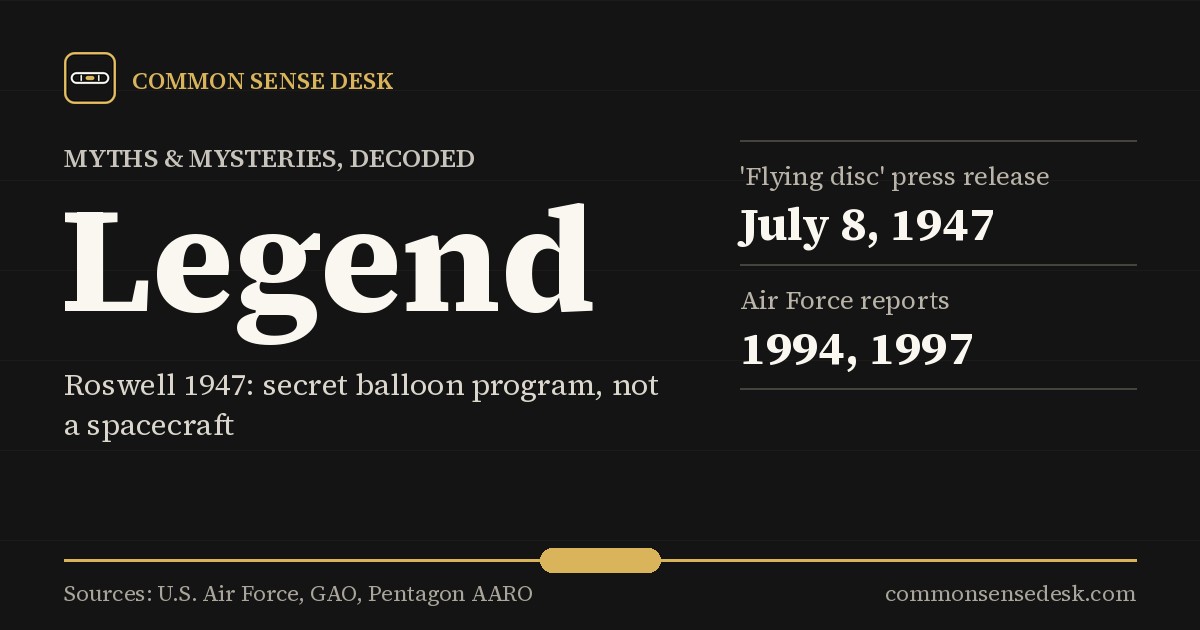
Legend. A real crash, a real secret and a real Army press release about a "flying disc." But the debris came from a classified balloon program, the alien-body stories surfaced decades later and match other events, and no investigation has found evidence of a spacecraft or aliens.
More from Common Sense Desk
Sources
- U.S. Air Force: The Roswell Report: Fact vs. Fiction in the New Mexico Desert (1994-95)
- U.S. Air Force: The Roswell Report: Case Closed (1997)
- Government Accountability Office: report to Rep. Steven Schiff on Roswell records (1995)
- All-domain Anomaly Resolution Office (Pentagon): Historical Record Report, Volume 1 (2024)
- Roswell Daily Record, July 8, 1947