

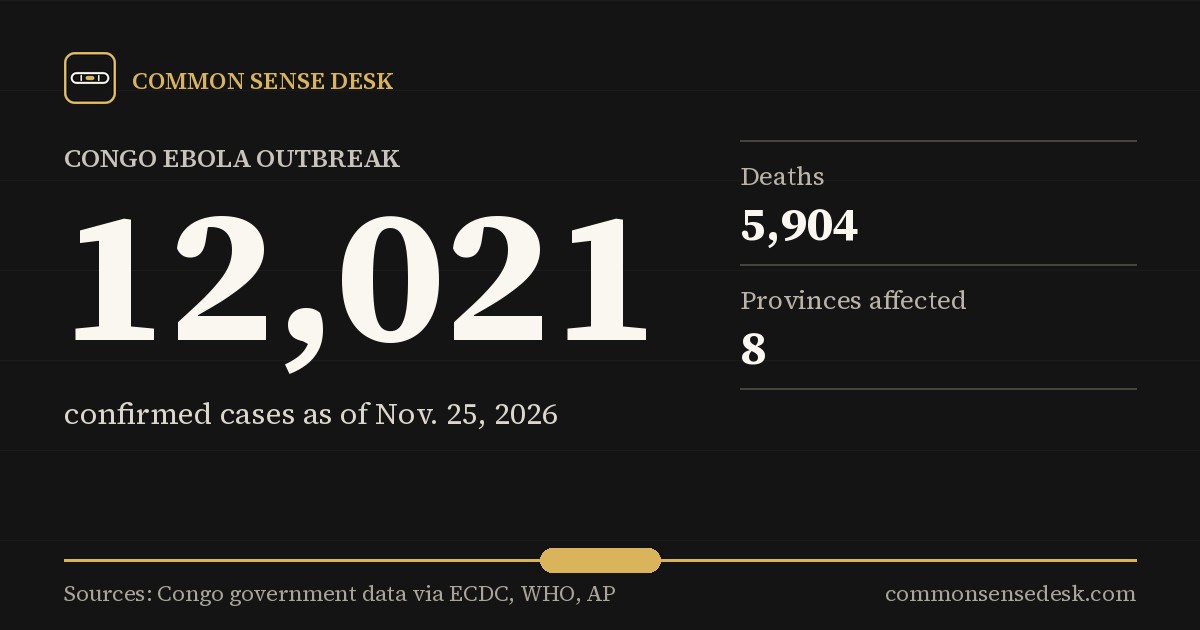
Congo's Ebola outbreak has now passed 12,000 confirmed cases. As of November 25, health authorities had counted 12,021 cases and 5,904 deaths, according to the latest Congolese government situation report as compiled by the European Centre for Disease Prevention and Control (ECDC). That is roughly half of everyone confirmed infected. And in the province where it all started, aid teams spent last week hiding from gunfire instead of tracing contacts.
On Tuesday, November 24, about a dozen people, including two World Health Organization staff and Congolese health officials, were evacuated to Bunia after three days trapped in a hospital in Akwe, northeast of the city. "They were caught really in the crossfire, very intense fighting, and we managed to evacuate them," Dr. Catherine Smallwood, WHO's Ebola incident manager, told the Associated Press. WHO chief Tedros Adhanom Ghebreyesus said the team had sheltered "for their lives" in the hospital's maternity ward, and called for "immediate safe passage and for the hospital facilities, staff and patients to be protected."
WHO also pulled its team out of Mongbwalu, the gold-mining town where the outbreak was first detected in May, after clashes between Congo's army and a rebel group, the Convention for the Popular Revolution (CRP), cut the roads around it. Staff from WHO and Africa CDC moved to Bunia, the provincial capital. A humanitarian worker, Sandrine Buju, told the AP her team came under fire on Monday. "We were surprised by gunfire about 15 meters (50 feet) from where we were," she said. "I was very frightened."
Why the fighting matters so much
Ebola is stopped by finding every person a patient touched and checking on them for 21 days. Lose track of those contacts and new chains of infection start out of sight. That is what Smallwood says is happening: teams can't reach some communities, monitoring of exposed people has been disrupted, and some treatment centers are running with fewer staff. In North Kivu, attacks by another armed group have displaced more than 20,000 people, and health teams lost track of Ebola contacts as families fled.
Even before last week, the numbers showed the strain. WHO's target is to see 95% of contacts every day; the two-week average in mid-November was 81%. Of the 720 deaths reported between October 28 and November 17, 452 happened at home or elsewhere in the community, not in a treatment center. A death at home usually means a sick person who was never isolated, and a body that relatives may handle at a funeral, which is one of the main ways Ebola spreads.
"Insecurity is now one of the greatest obstacles to the response," Tedros told WHO's emergency committee on November 17. WHO says it has verified more than 87 attacks on health care in Congo since January 1. Julien Harneis, the UN's senior Ebola response coordinator, told reporters in Geneva on November 13 that contact tracing in areas where the Allied Democratic Forces operate is "very hazardous," and warned that recent ADF attacks had killed more people than Ebola.
The CRP said on Tuesday it was halting its advance toward Bunia, and Congolese authorities said the army had pushed the rebels back. Residents told the AP the situation was still volatile on Wednesday. When, or whether, WHO's team can return to Mongbwalu has not been announced.
Read next: Ethiopia and Eritrea move troops to their border, raising fears of war
Where the cases are
Ituri, in the northeast, carries most of the outbreak: 8,140 confirmed cases and 3,843 deaths, with 28 of its 36 health zones affected. North Kivu, just to the south, has 3,181 cases and 1,779 deaths. Haut-Uélé has 561 cases and Tshopo 111. Small numbers have also turned up in Bas-Uélé, Nord-Ubangi, Sud-Ubangi and South Kivu. In all, 69 of Congo's 178 health zones across eight provinces have reported cases, and WHO says 400 to 500 new cases are still confirmed every week.
The cause is the Bundibugyo strain of the virus, a cousin of the Zaire strain behind most big Ebola outbreaks. Until this year it had caused only two known outbreaks, in Uganda in 2007 and in Congo in 2012, and both were small. This one has been hard on the youngest patients: WHO says seven in ten children under five with confirmed Ebola have died.
How it compares
This is the deadliest of Congo's 17 Ebola outbreaks, the AP reports. The previous worst, in North Kivu and Ituri from 2018 to 2020, had about 3,470 cases and 2,287 deaths over almost two years, also in a war zone. The current outbreak passed that case count within months of being declared. The only bigger Ebola outbreak on record is West Africa's in 2014 to 2016, with about 28,600 cases and some 11,300 deaths. The ECDC says Congo's real total is probably larger than reported, because of gaps in data and contact follow-up.
Spread beyond Congo
"The risk beyond the DRC's borders is not theoretical," Tedros said on November 17. Kenya has had nine cases, two of them fatal, all linked to one imported case; it has reported no new cases since October 19 and is counting down 42 days to declare its outbreak over. Nigeria had one imported case, a woman who had traveled from Uganda; she was flown to Switzerland for care and recovered. Uganda has had 20 confirmed cases and, according to the U.S. Centers for Disease Control and Prevention, no active ones now. Several infected aid workers were evacuated to hospitals in Europe.
WHO rates the risk in Congo as very high. It rates the risk as high for Kenya and Nigeria, and for countries with strong travel links to the affected areas but weak capacity to respond. For countries with good health systems, and for everyone else, it rates the risk as low. On November 18, Tedros confirmed the outbreak remains a public health emergency of international concern. WHO advises against travel or trade bans on affected countries and has criticized "blanket travel restrictions" that some governments still apply.
What it means for you
For people outside central and east Africa, the risk is very low. Ebola spreads through direct contact with the blood or body fluids of someone who is sick, or with the body of someone who died of it. It does not spread through the air like the flu, and people are not contagious before symptoms start. The CDC rates the risk to the American public as low, and the ECDC rates the risk to the general public in Europe as very low.
Travelers face real rules, though. The CDC advises against all travel to Ituri and North Kivu, says to reconsider nonessential travel to Haut-Uélé and Tshopo, and urges extra precautions in the rest of Congo and in Uganda. Anyone who has been in Congo in the past 21 days cannot board a commercial flight to the United States. Canada's Public Health Agency advises avoiding non-essential travel to Congo and has extended its temporary border measures. Anyone who comes back from the region and gets a fever within 21 days should call a doctor or health line before going in, and say where they have been.
More from Common Sense Desk
Sources
- ECDC: Ebola disease outbreak caused by Bundibugyo virus, update (Nov. 26, 2026) ecdc.europa.eu
- WHO: Disease Outbreak News, Ebola disease caused by Bundibugyo virus, DRC, Kenya and Nigeria (Nov. 20, 2026) who.int
- WHO: Director-General's opening remarks at the third IHR Emergency Committee meeting (Nov. 17, 2026) who.int
- AP (via Yahoo News): Fighting in eastern Congo forces Ebola workers to evacuate, threatening outbreak response (Nov. 25, 2026) yahoo.com
- UN News: Heavy fighting in Ituri traps DR Congo Ebola responders: WHO (Nov. 23, 2026) news.un.org
- CDC: Ebola outbreak, current situation (Nov. 27, 2026) cdc.gov
- Government of Canada: Ebola disease in Democratic Republic of the Congo, travel health notice (Nov. 2, 2026) travel.gc.ca